High-Efficiency Anodizing & Industrial Rectifier Series
Engineered for high current density, superior anodic film uniformity, and uncompromised uptime in demanding manufacturing environments across Dublin, Cork, Shannon, and Galway.

12V 15V 5000A 6000A 75KW Water Cooled Rectifier
- Output Rating:12V–15V / 5000A–6000A
- Cooling Method:Direct Deionized Water
- Control Modes:CV / CC Digital Display
- Efficiency:≥ 90% (IGBT Inverter)
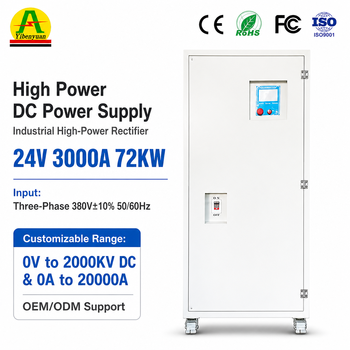
100A–3000A Modular Anodic Oxidation Rectifier
- Output Range:12V / 24V (100A–3000A)
- Application:Type II & III Anodizing
- Interface:RS485 / Modbus / 4-20mA
- Ramp Control:Multi-stage Soft Start
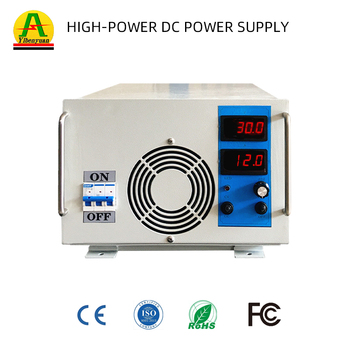
Titanium & Hard Aluminum Alloy Anodizing Source
- Voltage Rating:0–150V DC Variable
- Current Density:50A–500A Configurable
- Target Process:Hardcoat / Plasma Anodic
- Protection:Over-temp / Short / Spark

8000A 12V Industrial Water-Cooled DC Rectifier
- Output Power:96 kW Continuous
- Current Output:8000A Ultra-Low Ripple
- Enclosure:Sealed IP54 Anti-Corrosion
- Busbar:High Purity E-Copper T2
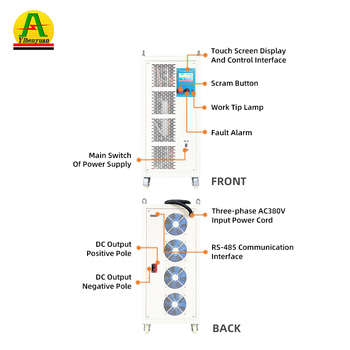
12V 4000A 48kW Switch-Mode DC Power Cabinet
- Power Topology:Full-Bridge Phase Shift
- Output Capability:0–12V / 0–4000A
- Ripple Factor:≤ 2% RMS Low Harmonic
- Duty Cycle:100% 24/7 Heavy Load
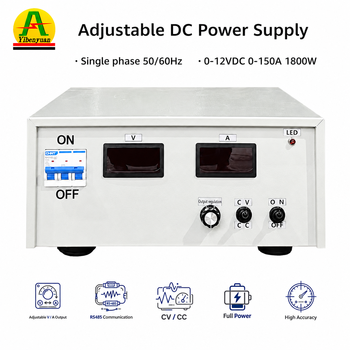
12V 150A Benchtop Laboratory DC Anodizing Source
- Form Factor:19-inch Rack / Benchtop
- Accuracy:±0.5% Voltage & Current
- Standards:CE, EMC, LVD, RoHS
- Usage:MedTech & Precision Prototyping

48V 625A Auto-Polarity Reversing Power System
- Nominal Power:30kW Digital IGBT
- Reverse Cycle:Programmed Millisecond Pulse
- Automation:4-Segment PLC Profile Timer
- Application:Chemical Etching & Descaling

300kW 20V 15000A Ultra-High Current DC Rectifier
- Nominal Current:15,000A High Yield
- Thermal Control:Closed-loop Liquid Cooling
- SCADA Ready:EtherCAT / Profinet Option
- Efficiency Rating:92.5% at Full Load
High-Precision Anodizing Applications Across Irish Industries
Ireland has transitioned from traditional light fabrication to high-value advanced manufacturing. Aluminum anodizing power supplies must meet hyper-specific regulatory and metallurgical demands within Ireland's core industrial clusters.
Medical Device & Surgical Orthopedics (Galway, Cork)
Ireland manufactures 50% of the world's ventilators and significant surgical implants. Anodizing titanium (Type II/Type III) and aluminum orthopedic enclosures requires absolute current stability (drift < 0.2%) and zero ripple harmonics to ensure bio-inert oxide layers and tight dimensional tolerances without microscopic pitting.
Our custom DC units support programmable multi-slope ramping, preventing micro-arcing and oxide delamination on high-value surgical equipment, complying with ISO 13485 cleanroom surface requirements.
Aviation MRO & Subcontract Machining (Shannon Cluster)
Shannon is Ireland's aerospace hub, hosting major maintenance, repair, and overhaul (MRO) facilities. Hardcoat anodizing (MIL-A-8625 Type III) for structural aluminum 6061-T6 and 7075 components demands chilled bath voltages exceeding 75V–100V under elevated current densities (2.5–3.5 A/dm²).
Fenvix switch-mode rectifiers integrate programmable pulse anodizing algorithms that reduce heat accumulation in sub-zero bath electrolytes, preventing "burning" while producing Rockwell hard anodic films.
Semiconductor Tooling & Data Infrastructure
With major fab nodes in Leixlip and enterprise server operations in Dublin, aluminum vacuum chambers, wafer handling arms, and liquid cooling distribution manifolds need premium anodic passivation. High breakdown voltages and deep micron pore control require stable constant current (CC) control with ±0.5% regulation accuracy.
Our OEM architectures interface directly with factory PLCs through Modbus RTU/TCP or Profinet, guaranteeing traceability of electrical load profiles per anodizing batch.
Engineering Evaluation: High-Frequency IGBT vs. Legacy SCR Rectifiers
Why Irish process engineers and facility managers are swapping traditional silicon-controlled rectifiers (SCR/Thyristor) for high-frequency switch-mode power systems.
| Performance Dimension | Legacy Thyristor / SCR Transformer | Fenvix High-Frequency IGBT Inverter | Benefit to Irish Anodizing Plants |
|---|---|---|---|
| Operating Efficiency | 70% – 78% (Significant magnetic losses) | ≥ 90% – 94% (Full phase shift) | Drastic reduction in kWh consumption under peak Irish grid tariffs. |
| DC Current Ripple (RMS) | 5% to 15% (Requires heavy choke filters) | ≤ 1% to 2% (Ultra-low harmonics) | Uniform pore diameter, eliminated burning, brighter color dyeing. |
| Power Factor (cos φ) | 0.65 – 0.75 (Lags significantly at partial load) | ≥ 0.93 to 0.96 (High across all load ranges) | Prevents ESB Networks reactive power surcharges and kVA penalties. |
| Physical Footprint & Weight | Heavy steel core, 1200+ kg for 40kW | Compact rack/cabinet, ~250–350 kg | Maximizes floor space inside modern Irish urban industrial parks. |
| Response Time | 20ms – 100ms (50Hz line dependent) | < 1ms (20kHz–40kHz switching) | Instant spark detection, preventing catastrophic load arc-through. |
Key Market Trends Governing Irish Metal Finishing (2025–2030)
Understanding shifting macroeconomic pressures, decarbonization targets, and automated industrial architectures in the Republic of Ireland.
Grid Decarbonization & Peak Tariff Mitigation
Industrial electricity rates in Ireland are among the highest in the European Union. Surface finishing operations run continuous multi-megawatt electro-chemical baths that face aggressive penalty tariffs during peak grid demand windows.
Modern anodizing shops are mandating power systems equipped with active power factor correction (PFC) and conversion efficiencies above 91%, directly reducing the facility's carbon tax liabilities under the Irish Climate Action Plan.
Stricter REACH Mandates & Sulfuric/Tartaric Shift
Environmental Protection Agency (EPA) Ireland inspections are accelerating the elimination of hexavalent chromium (Chromic Acid Anodizing - CAA). Finishing plants are transitioning toward Sulfuric-Boric (SBAA) and Tartaric-Sulfuric Acid (TSAA) anodizing baths.
These newer chemical processes operate within tight electrochemical windows that require pulse-reverse and high-resolution voltage step controls to achieve aerospace-grade corrosion barrier layers.
Industry 4.0 & Fully Automated Wet Process Lines
Modern Irish installations demand remote diagnostics and industrial bus integration. Standalone analog knobs are obsolete; power supplies must integrate into central PLC systems with real-time logging of amphour consumption, ripple percentage, bath temperature feedback, and fault diagnostics.
Every Fenvix anodizing unit features native digital bus integration, providing full compliance with automated medical and aerospace audit trails.
Why Tier-1 Manufacturers Partner with Fenvix
Combining rigorous hardware engineering with complete in-house manufacturing control. From bare sheet metal punching to final full-load burn-in testing.
Vertical In-House Fabrication
We do not outsource chassis construction. Our factory operates shearing, CNC punching, milling, drilling, and busbar tapping machines, providing complete control over mechanical tolerance and thermal heat sink integration.
100% Load & Burn-In Testing
Every industrial rectifier undergoes a multi-hour full-load thermal run and oscilloscope ripple test before packing. We guarantee non-derated continuous duty under your specified plant ambient temperature.
Zero MOQ Policy for OEMs
Whether you require a custom 150V/50A prototype unit for cleanroom R&D or a complete fleet of 10,000A water-cooled rectifiers for an automated plating line, we support single-unit engineering builds without order quantity penalties.
Direct DDP Export to Ireland
We handle export crating, marine/air documentation, and door-to-door delivery across Ireland (DDP terms). Complete with CE conformity documents, test curves, and English user manuals for seamless integration.
 CE Conformity
 RoHS Certified
 LVD Directive
 EMC Directive
 TÜV On-Site Verified
Frequently Asked Questions by Irish Industrial Engineers
Direct answers addressing voltage compatibility, environmental durability, and commercial delivery across the Irish market.
Are your power supplies compatible with Ireland's 400V 50Hz grid?
Yes. All industrial power units configured for the Irish market are built for standard 3-phase 400V AC (±10%) at 50Hz, or 230V single-phase for smaller laboratory models. The primary rectifying stage handles common Irish electrical grid variations without trip sensitivity.
When should we specify water cooling over air cooling in an Irish facility?
We recommend water cooling when power demands exceed 40kW–50kW, or where units sit close to sulfuric, chromic, or nitric acid tanks. Water cooling isolates electronic modules inside fully sealed IP54/IP55 enclosures, preventing acid aerosols from corroding the internal IGBT stages.
Can your rectifiers execute automated current density ramps?
Yes. In Type III hard anodizing, stepping voltage or current too fast causes catastrophic burning. Our controllers allow multi-step ramp profiles via front touchscreens or external PLC control (RS485 Modbus, analog 0-10V/4-20mA, or optional Ethernet/Profinet).
What documentation and CE certificates accompany shipments to Ireland?
Every unit ships with complete CE Declaration of Conformity documentation (Low Voltage Directive 2014/35/EU and EMC Directive 2014/30/EU), comprehensive electrical schematics, terminal connection maps, full-load test reports, and an English operation and maintenance manual.
What is the typical lead time for custom OEM builds delivered to Ireland?
Standard modular units (100A–2000A) typically manufacture within 2 to 3 weeks. Custom high-power water-cooled cabinets (5,000A–15,000A) take 3 to 4 weeks. Air shipping to Dublin Airport takes 5–7 days, while sea freight to Dublin or Cork Port takes approximately 30–35 days.
How do you handle technical support and warranty for Irish clients?
We provide a comprehensive 12 to 24-month replacement parts warranty. Our electrical engineering team supports you via direct video diagnostic sessions, remote telemetry reviews, and schematics consultations. Plug-and-play modular circuit designs allow easy swapping of parts by your local plant maintenance team.
Upgrade Your Anodizing Line with Custom Power Electronics
Send our senior engineering team your tank parameters, bath chemistry, target current density, and control requirements. We will prepare an optimized electrical configuration, thermal sizing, and quote within 24 hours.