Engineered DC Rectifiers for Hydrogen Stacks & Precision Electrolysis
Direct factory export configurations engineered in Guangdong by Fenvix Technology for German and European grid integration. Scalable from 15kW laboratory stacks to multi-megawatt electrolysis container stations.

12V–15V 5000A–6000A 75kW Water-Cooled Electrolysis Rectifier
- Output Rating:12V–15V / 5000A–6000A
- Power Stage:High-Frequency IGBT
- Thermal Design:Closed Water Cooling
- Ripple Current:≤ 2% RMS (Low-Degradation)

300kW 20V 15,000A Heavy-Duty Electrolysis Rectifier Unit
- Output Rating:20V DC / 15,000A Constant
- AC Input:3-Phase 380V/400V/480V
- Topology:Modular Multi-Pulse Bridge
- Efficiency:≥ 94.5% at Full Load
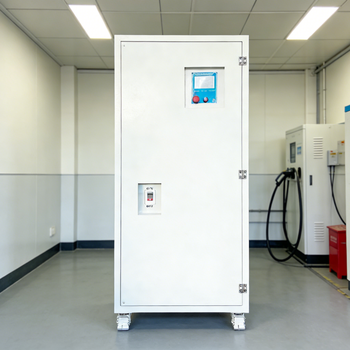
160kW 2500A High-Stability Electrolysis DC Power Unit
- Output Range:64V DC / 2500A Continuous
- Stack Suitability:Alkaline & AEM Cells
- Control Mode:Dual Mode (CC / CV) Digital
- Automation:Modbus-RTU / Profinet

8000A 12V Water-Cooled Modular High-Current DC Source
- Output:12V / 8000A Water-Cooled
- Enclosure:IP54 Sealed Cabinet
- Protection:Over-temp, Short, Phase loss
- Regulation:± 0.5% Accuracy
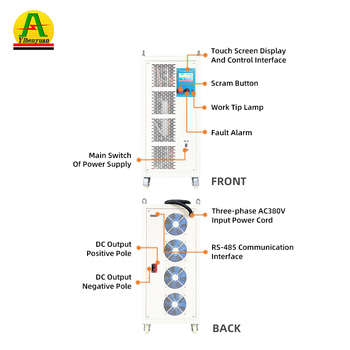
48kW 12V 4000A Compact Switch-Mode Electrolyzer Power
- Output:0–12V / 0–4000A Programmable
- Switching Freq:20kHz High Speed PWM
- Footprint:Compact High-Density Rack
- Certifications:CE, LVD, EMC, ISO 9001
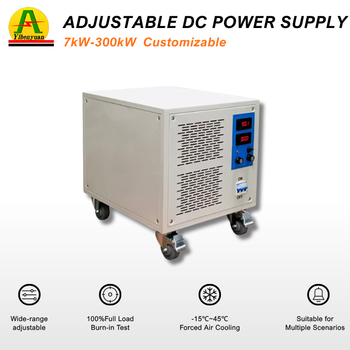
800V 50A 20kW Programmable PEM & SOEC Test Source
- Voltage Window:400V–800V DC Dynamic
- Current:0–50A Fast Transient Response
- Laboratory Use:Electrolyzer Stack Simulation
- Interface:0–10V Analog, RS485, USB

48V 625A 30kW Auto-Polarity Descaling & Stack Conditioning
- Reversal Logic:Millisecond Polarity Flip
- Output:0–48V / 0–625A Adjustable
- Stack Protection:Automated Anti-Fouling Cycles
- Timer Module:Multi-Program Forward/Reverse
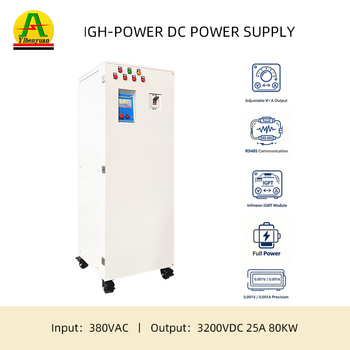
80kW 1000V–3200V High-Precision Multi-Cell Stack Tester
- Output Range:1000V–3200V DC / 16A–25A
- Application:High-Voltage Series Electrolysis
- Stability:≤ 0.1% Full Range Drift
- Control Unit:Touchscreen Microprocessor
Whitepaper: Engineering High-Current Direct Current Architectures for Water Electrolysis
In modern industrial green hydrogen production, the Direct Current (DC) power supply and rectifier architecture represents between 15% and 25% of total electrolyzer Balance of Plant (BOP) capital expenditure, while directly determining over 70% of the operational energy losses over a 20-year stack lifecycle. As the state of Bavaria accelerates the implementation of the Bayerische Wasserstoffstrategie 2.0, municipal utility operators, chemical refineries, and mobility infrastructure developers across the Munich Metropolitan Region face stringent technical requirements concerning grid compliance, dynamic ramp rates, harmonic distortion, and stack protection.
1. The Electrochemical Physics of Power Quality: Ripple Current vs. Catalyst Degradation
Water electrolysis—whether utilizing traditional Alkaline Electrolysis (AEL), advanced Proton Exchange Membrane (PEM), or emerging Anion Exchange Membrane (AEM) technologies—relies upon Faraday's laws of electrolysis, where hydrogen production volume is strictly proportional to direct electric charge (coulombs). However, the DC current waveform delivered by the power supply is never mathematically flat.
Conventional silicon-controlled rectifiers (SCR / Thyristor-based power systems) generate substantial low-frequency ripple components (typically 300Hz in 6-pulse systems, or 600Hz in 12-pulse configurations) exceeding 5% to 8% without massive filter chokes. In alkaline stacks, excessive ripple causes periodic micro-voltage depressions below the thermoneutral voltage (1.48V per cell at standard conditions). When cell voltage periodically sags, parasitic reverse polarization currents occur, stripping the catalytic platinum-group metal (PGM) coatings or nickel-iron active surfaces from the porous transport layers. This phenomena accelerates irreversible catalyst leaching and membrane degradation.
Technical Distinction: Fenvix high-frequency switch-mode power supplies (SMPS) utilize high-power Insulated-Gate Bipolar Transistors (IGBTs) switching at 15kHz to 25kHz. Combined with custom-wound nanocrystalline magnetic cores and active LC filtering, our systems constrain residual ripple to ≤ 1.5% RMS across the entire 10%–100% current operating window, mitigating membrane pitting and extending stack life beyond 80,000 operational hours.
2. Dynamic Ramp Rates in Renewable Coupling: Addressing Bavarian Solar & Wind Fluctuations
Under European Union Renewable Energy Directive (RED III) standards, green hydrogen production requires strict temporal correlation with renewable electricity sources. Munich industrial operators integrating rooftop photovoltaic systems, Bavarian Alpine run-of-river hydro plants, or regional wind turbines must accommodate violent input power shifts. Conventional SCR rectifiers exhibit slow closed-loop response times (100ms to 300ms) due to mains 50Hz phase-angle control constraints.
Fenvix programmable IGBT-based electrolysis power supplies incorporate 32-bit digital signal processors (DSP) operating field-oriented control algorithms. This delivers a dynamic slew rate adjustable from 0% to 100% current output in under 5 milliseconds without generating output overshoot voltage spikes. This instantaneous response prevents local stack dry-out and thermal shock during rapid renewable load fluctuation—a critical safeguard for PEM systems operating in dynamic dispatch mode.
Targeted Electrolysis Applications Serving the Greater Munich Ecosystem
Engineering customized direct current solutions that integrate seamlessly into Southern Germany's green energy transition, research corridors, and chemical infrastructure.
Heavy Mobility & Bus Refueling Hubs
Powers high-pressure PEM electrolysis stations for regional transit operators like Stadtwerke München (SWM) and logistics corridors along the A9/A8 Autobahns. Delivers 24/7 continuous 48V–120V, up to 10,000A DC under varying load schedules to supply 350-bar and 700-bar fleet dispensers.
ChemDelta Bavaria Industrial Integration
Supplying the Burghausen chemical triangle and downstream industrial consumers with high-capacity megawatt-scale alkaline electrolysis DC power. Engineered with sealed IP54 enclosures and closed-loop liquid-to-liquid heat exchangers resilient to corrosive chemical facility environments.
Academic R&D & Pilot Test Facilities
Tailored high-precision, low-current (800V–3200V / 20A–100A or 12V / 500A) programmable power sources deployed across research laboratories at the Technical University of Munich (TUM), Garching Energy Campus, and private research institutes for advanced SOEC and AEM material testing.
Grid Compliance & Power Engineering Specifications for the Munich Network
Deploying heavy industrial power supplies into the German power grid requires compliance with strict VDE (Verband der Elektrotechnik Elektronik Informationstechnik) standards and European Union directives. Equipment connecting to Munich's medium-voltage or low-voltage network must not pollute the local grid with excessive reactive power or harmonic currents.
| Technical Parameter | Legacy SCR Rectifier (Typical) | Fenvix High-Frequency IGBT Solution | Munich / EU Engineering Impact |
|---|---|---|---|
| Conversion Efficiency | 86% – 90% (High resistive loss) | 94.0% – 96.2% | Saves up to 180,000 kWh annually per MW installed in Bavaria |
| Total Harmonic Distortion (THDi) | 28% – 38% (Requires active traps) | ≤ 3.0% (With Active Front End) | Full compliance with DIN EN 50160 & VDE-AR-N 4110 medium voltage |
| Power Factor (&cos;φ) | 0.70 – 0.82 (Degrades at low load) | ≥ 0.98 across all loads | Eliminates utility reactive power penalty surcharges from SWM |
| Current Output Ripple | 5.0% – 8.0% RMS (Low-frequency) | ≤ 1.5% RMS | Prevents catalyst poisoning; doubles PEM membrane lifespan |
| Cooling System Medium | Raw ambient forced-air cooling | Closed-Loop Demineralized Water | Allows heat recovery integration into Munich district heating grids |
| Cabinet Footprint / Weight | 100% baseline (Extremely heavy) | 40% – 55% reduction | Fits standard 20ft / 40ft ISO shipping containerized balance-of-plant |
Integrated PLC Communication for SCADA and Automated Stacks
German engineering practices mandate comprehensive integration with industrial distributed control systems. Fenvix hydrogen electrolysis power systems come equipped with native industrial fieldbus cards. Standard protocols include Profinet IO, Modbus TCP/IP, and EtherCAT, enabling plug-and-play parameter mapping into Siemens Simatic S7-1500 PLCs and Beckhoff industrial control systems. Process engineers in Munich can monitor cell voltage, busbar temperatures, coolant flow velocity, phase balance, and instantaneous kilowatt consumption with millisecond-resolution telemetry.
Why Leading European Energy Integrators Partner with Fenvix
Operating an advanced ISO 9001:2015 certified manufacturing facility in Guangdong, China since 2013, Fenvix eliminates intermediary markups while providing full engineering customization.
TÜV Rheinland Verified
Our Guangdong manufacturing floor, electrical test bays, and quality assurance processes have been inspected and verified on-site by TÜV Rheinland for maximum European procurement confidence.
In-House Heavy Fabrication
From sheet metal laser shearing, punching, and CNC copper busbar bending to transformer winding and final load-bank burn-in, we maintain complete control over quality and delivery schedules.
0 MOQ Flexibility
Whether you require a single bespoke 20kW rectifier for university laboratory pilot trials or fifty 300kW containerized units for commercial plant scaling, we welcome single-set orders.
DDP Munich Door Delivery
Comprehensive international logistics including direct sea freight to Hamburg/Rotterdam, customs clearance, and inland transit to Bavarian facilities under Incoterms DDP, CIF, or DAP.
Munich Procurement & Technical FAQ
Direct answers to technical, commercial, and regulatory inquiries commonly raised by German plant operators, EPC contractors, and system engineers.
Q Do your power supplies comply with German and European CE / Low Voltage Directives?
Yes. All Fenvix export power systems are engineered in strict compliance with the European Low Voltage Directive (LVD 2014/35/EU) and Electromagnetic Compatibility Directive (EMC 2014/30/EU). Units carry CE marking, comply with RoHS environmental limits, and individual test reports are supplied alongside the technical documentation dossier with every export shipment.
Q How does water cooling operate under cold Bavarian winter ambient conditions?
For installations in Southern Germany subjected to sub-zero winter temperatures, Fenvix supplies dual-circuit closed-loop liquid cooling modules compatible with inhibited water-glycol mixtures (up to 40% ethylene/propylene glycol). Internal heatsink thermal sensors and motorized bypass valves regulate coolant temperature above dew point, preventing internal cabinet condensation while guaranteeing optimal IGBT junction temperatures.
Q What are the lead times for custom-built 100kW–500kW electrolysis power supplies?
Standard pilot-scale and mid-power units (15kW to 100kW) typically require 3 to 4 weeks for fabrication and 72-hour continuous burn-in testing. Tailored high-power systems (150kW to 500kW+) requiring non-standard voltages or specialized busbar topologies generally ship within 5 to 7 weeks from engineering drawing approval. Express air freight or regular maritime shipping to Munich is coordinated according to project milestones.
Q Can Fenvix power supplies be integrated with existing Siemens PLC control networks?
Absolutely. Our control architecture natively supports Profinet, Modbus-TCP, and RS485 communication protocols. We provide pre-configured GSDML files and memory register maps that allow rapid block integration into Siemens TIA Portal environments, enabling remote setpoint ramping, error acknowledgement, and instantaneous voltage/current datalogging without proprietary gateway converters.
Q How does Fenvix support commissioning, warranty, and field servicing in Germany?
We provide full pre-sales engineering schematics, cable sizing calculations, and step-by-step remote video commissioning supervised by senior power electronics engineers. All units include a 12-to-24-month factory warranty backed by express dispatch of modular plug-and-play driver boards and power modules. Third-party verified on-site engineering support can also be scheduled across the DACH region.
Q What parameters must be specified when requesting a project quotation?
To ensure optimal power stage sizing, provide: (1) Mains AC supply voltage and frequency; (2) Stack operating DC voltage window (min/nominal/max); (3) Rated and peak DC current; (4) Electrolyzer chemistry (PEM, AEL, or AEM); (5) Cooling utility availability (chilled water or ambient); (6) Desired fieldbus communication; and (7) Enclosure mounting restrictions.
Accelerate Your Hydrogen Electrolysis Project in Munich
Connect directly with Fenvix power electronics design engineers. Receive comprehensive product specification sheets, dimensional drawings, and competitive factory-direct pricing within one business day.