Capacitor Charging High Voltage Power Supply Factories & Exporters Serving the San Salvador Market
Precision High-Voltage Switch-Mode Topologies (1kV to 100kV) Engineered for Industrial Automation, R&D Research, Medical Aesthetics, and Electrochemistry Across the Greater San Salvador Metropolitan Area.
High-Voltage & Industrial DC Power Systems for San Salvador Sourcing
Custom-engineered power converters manufactured under ISO 9001 quality frameworks, verified by TÜV Rheinland on-site audits, and configured for Central America's 60Hz grid architectures.
Technical White Paper: High-Voltage Capacitor Charging Topologies for Modern Industrial Systems
Capacitor charging high-voltage power supplies represent a specialized branch of switch-mode power conversion engineering. Unlike conventional constant-voltage or constant-current DC sources that supply power to static resistive or dynamic electronic loads, a capacitor charger interacts directly with a complex reactive impedance profile that transitions from a virtual short-circuit (zero volts across the capacitor terminals at $t_0$) to full potential ($V_{max}$) in millisecond-to-second repetition intervals. In industrial manufacturing environments across San Salvador and the wider Central American regional market, deploying standard DC switching sources for pulsed applications invariably leads to premature component failure, severe thermal runaway across the primary switching semiconductors, and debilitating mains voltage distortions.
Information Gain Insight: The fundamental design challenge of capacitor charging lies in the instantaneous transfer of energy. When charging an uncharged capacitor with a classic resistive source, precisely 50% of the energy drawn from the power supply is dissipated as heat within the internal and external charging path resistance ($E_{loss} = \frac{1}{2} C V^2$), yielding a maximum thermodynamic efficiency ceiling of 50%. High-frequency series resonant (LCC) power converters manufactured by Fenvix eliminate this theoretical limitation, achieving operational efficiencies in excess of 88% to 92% by maintaining constant current during the charging curve via zero-current switching (ZCS) and zero-voltage switching (ZVS) mechanisms.
1. The Physics of Constant-Current High-Frequency Resonant Topologies
Modern industrial pulsed loads—ranging from flashlamp-pumped medical lasers to electromagnetic pulse (EMP) forming networks and electrostatic dedusters—require uniform repetition rates and tightly controlled shot-to-shot voltage reproducibility. To achieve this, our engineering framework employs a series-parallel resonant LCC converter topology operating at switching frequencies between 20 kHz and 100 kHz. When configured as a current source, the LCC topology inherently delivers a constant charging current ($I_c$) directly proportional to the switching frequency and resonant tank parameters, independent of the instantaneous load voltage:
P_{peak} = C \cdot V_{target} \cdot \left(\frac{dV}{dt}\right) = 2 \cdot P_{average} \quad \text{under pure linear ramp conditions}
By leveraging high-speed insulated gate bipolar transistors (IGBTs) coupled to high-voltage planar or custom-wound ferrite transformers, the power supply charges the external capacitive bank linearly from 0V to target setpoint. This eliminates the instantaneous current spikes that typically trip upstream breakers or stress municipal utility transformers in suburban Salvadoran industrial zones such as Soyapango, Ilopango, and Nejapa.
2. Quench and Inherent Short-Circuit Survival Mechanics
During pulsed discharges (e.g., in laser activation, pulsed magnetic forming, or spark gap testing), the capacitor is dumped directly into an ultra-low impedance load, generating transient back-EMF, severe ringing currents, and instantaneous output short-circuits. Standard DC supplies experience immediate component breakdown under these conditions due to overcurrent stress on secondary rectifier diodes and excessive dV/dt feedback. Fenvix integrates three levels of hardware protection:
Sub-Microsecond Inhibit (Quench) Signal: High-speed optical or TTL trigger circuitry halts IGBT switching within 500 nanoseconds upon receiving the external discharge command, ensuring the power supply does not attempt to supply energy into the short-circuit arc.
Inverse Voltage Suppression Diodes & Snubbers: Heavy-duty fast-recovery antiparallel diode arrays clamp reversal voltages up to 30% of rated voltage, safely shunting inductive kickback away from internal secondary transformers.
Active Resonant Tank De-tuning: If an arc persists, the primary control stage immediately alters the pulse width modulation (PWM) phase angle, transforming the resonant network into an ultra-high impedance state without blowing DC bus fuses.
Localized Industrial Applications in the San Salvador Metropolitan Region
From advanced manufacturing Free Trade Zones to specialized medical hubs and national testing facilities, discover where high-voltage capacitor charging infrastructure is driving El Salvador's technological transformation.
Medical Aesthetic & Surgical Laser Systems
San Salvador's thriving private hospital networks (such as Hospital de Diagnóstico and Escalón medical complexes) require reliable 1kV–3kV capacitor charging modules for Nd:YAG, Er:YAG, and intense pulsed light (IPL) dermatological and surgical devices, demanding shot-to-shot energy precision under ±0.2%.
Export Electronics Assembly (Zonas Francas)
In export processing centers like American Park, San Marcos, and El Pedregal, precision 10kV–80kV capacitor chargers power automated component potting testing, film capacitor endurance burn-in racks, and non-destructive pulsed X-ray inspection equipment.
Industrial processing facilities in Nejapa, Apopa, and along the Carretera a Santa Ana utilize continuous high-voltage power supplies (30kV–100kV) for electrostatic precipitators (ESP), separating fly ash, cement particles, and agro-industrial particulate from exhaust gas streams.
Academic & Applied Research Laboratories
Laboratories at the Universidad de El Salvador (UES) and specialized polytechnic institutes rely on programmable high-voltage DC and pulsed power modules for plasma physics experiments, high-energy material synthesis, and dielectric breakdown testing.
Engineering Comparison: Fenvix Resonant Topologies vs. Legacy Architectures
Operating industrial equipment in the San Salvador valley demands resilience against local electrical grid characteristics. El Salvador's primary industrial distribution operates at 60Hz (typically 208V, 220V, or 480V 3-phase). Due to seasonal lightning storms across the Cordillera Central and industrial load switching, line voltage fluctuations of ±10% to ±15% are common. The table below details why modern LCC resonant switch-mode architectures outperform legacy linear resistive or basic hard-switched converters in these demanding environments.
Direct manufacturer capabilities headquartered in Guangdong, China. Fenvix provides direct engineering collaboration without trading intermediaries, ensuring rigorous quality assurance for Salvadoran industrial importers.
ISO 9001 & TÜV Rheinland Verified
Our 3,000m² manufacturing facility operates strictly under ISO 9001 quality management procedures, featuring third-party on-site facility validation and product conformance to CE, LVD, and EMC directives.
In-House Mechanical Fabrication
We maintain full ownership of internal sheet-metal processing, including plate shearing, CNC punching, milling, drilling, and electrolytic copper busbar tapping, guaranteeing unmatched mechanical rigidity and thermal heat sinking.
Full-Load Burn-In & Oscilloscope Calibration
Every single high-voltage capacitor charger undergoes rigorous 100% full-duty burn-in cycles connected to reactive capacitive test dummy banks, logging waveforms and insulation resistance prior to export packaging.
Direct Logistics Serving San Salvador
Comprehensive export documentation handling multi-currency transactions (USD, EUR) under FOB, CIF (Puerto de Acajutla), and door-to-door DDP arrangements via Aeropuerto Internacional San Salvador (SAL).
Procurement & Technical FAQ for Salvadoran Engineering Teams
Direct answers addressing technical configuration, import mechanics, grid compliance, and operational best practices for importing industrial power systems to El Salvador.
How do Fenvix high-voltage power supplies handle San Salvador’s 60Hz grid fluctuations?
Our power supplies are designed specifically for global industrial variance. For equipment bound for El Salvador, we configure the primary input stages to tolerate nominal 208V, 220V, or 480V 3-phase AC at 60Hz, with an active dynamic input window of ±15%. Integrated active power factor correction (PFC) circuitry and transient surge suppressors (MOVs) buffer against municipal grid drops and voltage spikes caused by intense seasonal electrical storms across San Salvador.
What parameters are required to calculate the exact charging rate (Joules/second) for our capacitor bank?
To correctly size your capacitor charger, our engineering team requires: (1) Total capacitance in microfarads ($\mu F$), (2) Desired peak target voltage ($V_{peak}$), (3) Repetition frequency in Hertz ($Hz$) or required charging time in seconds, and (4) Initial residual voltage if the capacitor is not fully discharged during each cycle. Using the formula $P_{kJ/s} = \frac{1}{2} C (V_{peak}^2 - V_{init}^2) \times f$, we determine the precise peak and average power rating to prevent thermal undersizing.
Can Fenvix accommodate single-unit orders for prototyping, or is there a Minimum Order Quantity (MOQ)?
We maintain a strict No Minimum Order Quantity (MOQ: 1 unit) policy. We regularly engineer custom, single-unit high-voltage modules for university laboratories, specialized medical device OEMs, and private automated assembly plants in San Salvador before progressing to multi-unit batch manufacturing.
How are high-voltage power supplies shipped to San Salvador, and what are the typical lead times?
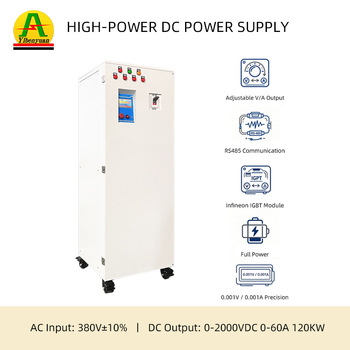
Standard custom engineering and manufacturing lead times range from 3 to 5 weeks depending on power tier (e.g., 5kW rackmount vs. 120kW heavy-duty cabinet). Shipments to El Salvador are primarily dispatched via air freight directly to Aeropuerto Internacional Monseñor Óscar Arnulfo Romero (SAL) for urgent installations (5-7 transit days) or sea freight via the Pacific port of Puerto de Acajutla (25-35 transit days) under standard Incoterms including CIF, CFR, and FOB.
What remote automation interfaces are provided for SCADA and PLC integration?
All programmable units feature isolated industrial interfaces. Digital options include RS485 / RS232 running standard Modbus-RTU protocols, as well as optional Ethernet / CANbus ports. Analog interfaces utilize fully isolated 0–10V or 4–20mA programming and monitoring signals for external PLC control, alongside high-speed optocoupled inhibit/enable lines for instantaneous pulse synchronization.
How does the tropical climate in San Salvador affect cooling choices (Air vs. Water Cooled)?
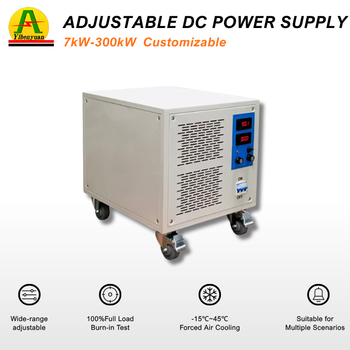
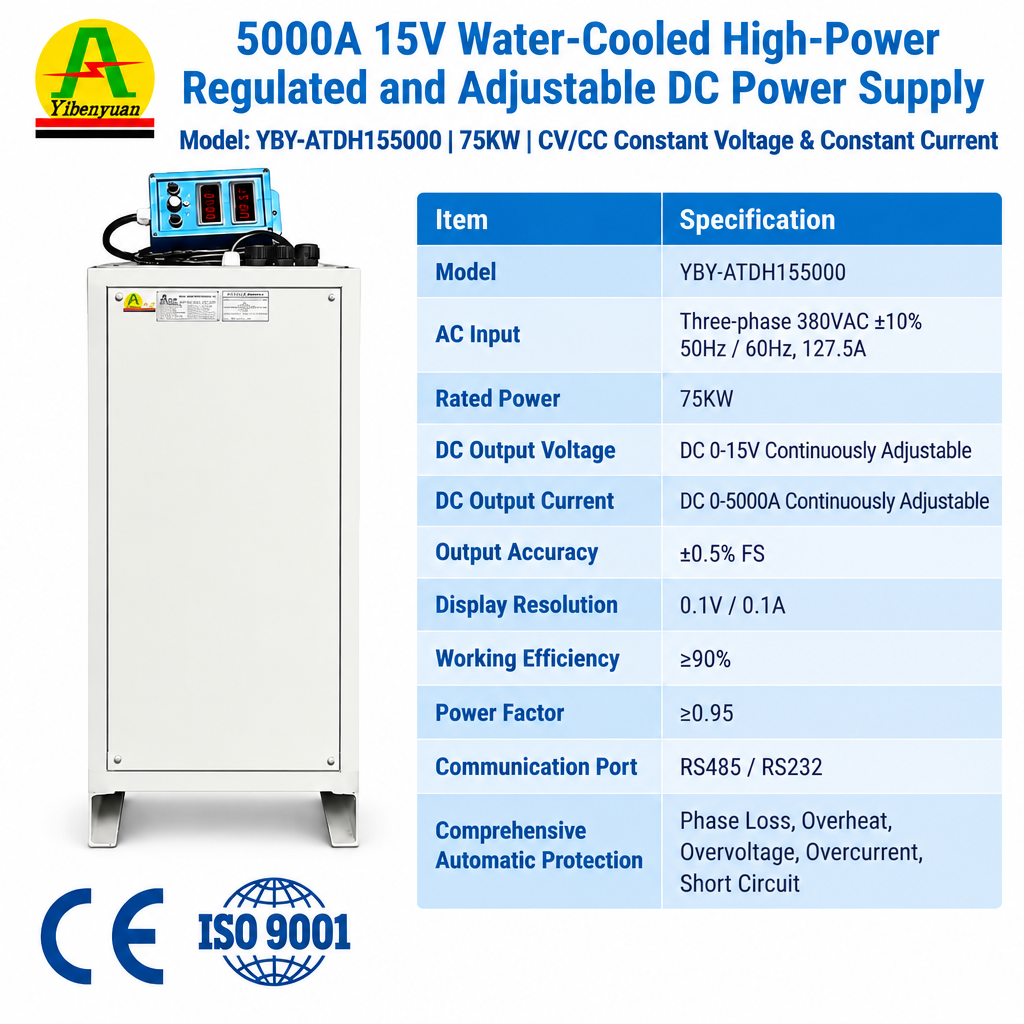
San Salvador’s ambient temperatures and high relative humidity (particularly in the wet season) are critical thermal variables. For power ratings up to 20kW operating in air-conditioned cleanrooms or laboratories, forced air cooling with conformal-coated PCBs provides optimal reliability. For high-power installations exceeding 30kW–80kW or units operating on factory floors exposed to corrosive humidity or particulate, closed-loop deionized water cooling is strongly recommended to protect internal semiconductors from environmental fouling.
Accelerate Your High-Voltage Project in San Salvador
Consult directly with our high-power conversion engineering specialists. Receive a detailed electrical schematic, comprehensive thermal modeling, and a competitive direct-factory quotation within 24 hours.