Aluminum Anodizing Power Supply Factory & Exporters for the Iceland Market
Precision IGBT High-Frequency Switching Rectifiers, Pulse Anodizing Modules & Corrosive-Atmosphere Water-Cooled DC Systems Engineered for Icelandic Smelters, Geothermal Facilities, and Maritime Finishing.
Precision Current Engineering
High-Efficiency Anodizing Rectifiers & Power Units
Field-proven switch-mode DC architectures optimized for high dielectric breakdown resistance, low ripple factors, and 24/7 continuous duty cycles in sub-arctic and geothermal processing conditions.
Technical Whitepaper: Precision Anodic Oxidation in the Icelandic Industrial Framework
The Republic of Iceland possesses one of the world's most unique metallurgical and electrochemical industrial profiles. Powered almost 100% by sovereign geothermal and hydroelectric renewable resources, Iceland's primary aluminum sector—anchored by major international smelting facilities in Grundartangi, Straumsvík, and Reyðarfjörður—serves as the cornerstone of its export economy. However, an increasing structural transition is underway across the Icelandic manufacturing landscape: moving up the industrial value chain from unworked primary ingots, rolling slabs, and extrusion billets toward advanced downstream precision fabrication and surface finishing.
Operating an aluminum anodizing line in Iceland requires specialized engineering considerations fundamentally distinct from standard continental workshops. Surface treatment facilities located across the Capital Region (Höfuðborgarsvæðið) and coastal industrial hubs must contend with a corrosive sub-polar maritime marine environment characterized by relentless salt-laden gales, coupled with regional airborne geothermal traces of hydrogen sulfide (H2S). Traditional thyristor-based (SCR) rectifiers with standard open forced-air ventilation suffer accelerated copper busbar sulfidation, premature electronic component breakdown, and excessive harmonic disturbance on isolated regional power grids.
Guangdong Fenvix Technology Co., Ltd. supplies high-frequency switch-mode power supplies (SMPS) specifically tailored for this exacting operating envelope. By combining zero-gap IGBT inverter modules, sealed internal atmospheric topologies with liquid-to-water heat exchangers, and precise digital closed-loop regulation, Fenvix DC rectifiers ensure that Icelandic anodizers achieve uniform oxide layer growth, dense pore structures, and peerless electrochemical efficiency while maximizing the carbon-neutral advantages of the local green electrical supply.
Targeted Deployment
Localized Application Scenarios Across Iceland
From pelagic maritime harvesting equipment to geothermal structural components, our power supplies are configured to match specific industrial bath chemistries.
Marine & Fisheries Hardware
Aluminum marine alloys (5xxx and 6xxx series) deployed in Icelandic trawlers, aquaculture pen collars, processing conveyors, and deck winches require heavy Type II and Type III hard anodizing to prevent pitting in North Atlantic salt spray. Fenvix constant-current rectifiers with soft ramping prevent catastrophic burning at high current densities.
Geothermal Plant Auxiliary Systems
Geothermal power installations across Hellisheiði, Nesjavellir, and Reykjanes utilize aluminum enclosures, ducting, and instrumentation manifolds. These components require specialized sulfuric-boric or dense hardcoat oxide layers to withstand ambient sulfur dioxide and hydrogen sulfide. Our sealed liquid-cooled cabinets eliminate atmospheric ingress.
Architectural Facades in Extreme Weather
Reykjavík's contemporary architecture relies heavily on anodized exterior aluminum cladding resistant to rapid freeze-thaw cycles, gale-force precipitation, and high UV reflectance. Fenvix rectifiers maintain an ultra-tight ±0.5% voltage and current stability to ensure total color and thickness uniformity across thousands of square meters of panels.
Emerging Trends in Icelandic Industrial Electrochemical Finishing
As Iceland progresses toward its stated national objective of complete carbon neutrality and environmental sustainability, the manufacturing sector is subjected to rigorous audit metrics. Industrial finishing shops are rapidly abandoning legacy 6-pulse and 12-pulse silicon-controlled rectifiers (SCR) due to three defining industry developments:
1. Strict Power Quality Compliance with Landsnet Transmission Regulations: Legacy thyristor rectifiers inject substantial low-order harmonic currents (5th, 7th, 11th) back into the distribution network and operate with a poor power factor (often 0.65 to 0.78 at reduced firing angles). In regional Icelandic sub-grids, harmonic pollution incurs direct penalties from regional grid operators (Landsnet / Rarðik). Fenvix high-frequency switch-mode units employ advanced active or passive filtering to deliver a power factor exceeding 0.94 and low total harmonic distortion (THD < 5%), drastically reducing reactive power consumption.
2. Adoption of Pulse and Reverse-Pulse Anodizing for High-Silicon Alloys: Processing complex cast components (such as marine engine brackets or custom alloy fixtures) has historically been problematic under DC steady-state anodizing due to localized heating, burning, and inhomogeneous barrier layer formations. Icelandic process engineers are transitioning to programmable high-frequency pulse-reverse rectifiers. By alternating positive oxide-building pulses with momentary negative dissipation pulses, process heat is evacuated from the pore base, allowing higher current densities (up to 3-4 A/dm2) and cutting tank processing durations by 30% without sacrificing film hardness.
3. Closed-Loop Liquid-Cooled Infrastructure to Eliminate H2S Downtime: In regions surrounding geothermal activity, standard air-cooled power equipment forces corrosive ambient air through cooling fins, leading to silver migration, electrolytic capacitor shorting, and busbar tarnishing. The modern industry standard across Iceland is fully sealed IP55/IP65 cabinets with internal water-to-water or chilled glycol heat exchangers, completely isolating sensitive power electronics from external environmental contaminants.
System Specification
Engineering Selection Matrix for Anodizing Applications
Consult the performance parameters below to size power stages correctly against your tank volumes and alloy requirements.
Anodizing Category
Electrolyte System
Operating Voltage
Recommended Current Density
Optimal Fenvix Rectifier Configuration
Type II Architectural Anodizing
Sulfuric Acid (H2SO4 160-200 g/L)
12V – 24V DC
1.2 – 1.8 A/dm2
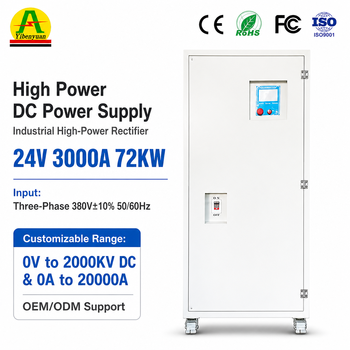
12V/24V 3000A–8000A IGBT Water-Cooled Switch-Mode
Type III Hardcoat Anodizing
Low-Temp Sulfuric (-2°C to +4°C)
40V – 100V DC
2.5 – 5.0 A/dm2
60V/100V High-Voltage Rectifier with Ramp-Up Stepper
Pulse Hard Anodizing
Organic Acid / Mixed Sulfuric
0 – 80V Peak
Up to 6.0 A/dm2 peak
Programmable Pulse Rectifier with Duty Cycle Control (10-90%)
Titanium Anodizing (Color/Bio)
Phosphoric / Ammonium Sulfate
60V – 150V DC
0.5 – 1.5 A/dm2
150V 50A–100A Precision Constant-Current Switcher
Continuous Coil / Extrusion Line
High-Speed Sulfuric Tank
18V – 36V DC
High Current Continuous
300kW Megawatt Modular Rack System (Up to 15,000A)
Manufacturing Rigor
Why Direct Sourcing from Fenvix Powers Icelandic Industry
A vertically integrated Chinese OEM/ODM engineering facility delivering customized electrochemical equipment without distributor markups.
ISO 9001 & TÜV Audited
Operating an audited ISO 9001 quality management framework since 2013, our production facility has passed comprehensive on-site technical inspection by TÜV Rheinland.
Full In-House Fabrication
We execute internal CNC shearing, punching, milling, and copper busbar bending within our 3,000 m² plant, eliminating third-party structural delays and maintaining strict mechanical tolerance.
100% Full-Load Burn-In
Before dispatch, every single power cabinet undergoes multi-hour continuous full-current burn-in against inductive and resistive load banks, verified by high-precision oscilloscopes and thermal imaging.
Zero MOQ & Custom R&D
Whether you require a single 150A prototype for testing marine coatings or a full 15,000A containerized multi-tank installation, we support single-unit custom engineering with full OEM documentation.
Procurement Intelligence
Frequently Asked Questions by Icelandic Engineers & Importers
Detailed technical, regulatory, and logistics answers for surface finishing operators throughout Iceland.
How do Fenvix rectifiers match Iceland's standard electrical grid and Landsnet harmonics regulations?
Iceland standard industrial mains supply is 400V 3-phase, 50Hz (TN-C-S / TN-S grounding system). All Fenvix export units destined for Iceland are wound, configured, and certified natively for 400V ±10% at 50Hz. Unlike older thyristor systems that create massive phase lag and harmonic noise, our high-frequency IGBT switch-mode systems utilize three-phase full-bridge rectification followed by high-frequency inversion (20kHz–40kHz), resulting in an intrinsic displacement power factor ≥ 0.94 and low current distortion that conforms to European EMC and harmonic emission directives (EN 61000-6-2, EN 61000-6-4).
Can the internal electronics withstand hydrogen sulfide (H2S) in Icelandic geothermal zones?
Yes. For Icelandic operations near geothermal fields (e.g., Reykjanes, South Iceland, or Hengill), atmospheric H2S rapidly reacts with bare copper and silver soldering to cause micro-arcing and circuit failure. For these installations, Fenvix specifies sealed IP55/IP65 cabinets featuring internal closed-circuit deionized liquid-to-water heat exchangers. Internal electronic cards receive triple-layer polyurethane/silicone conformal anti-corrosion coating, and primary AC/DC busbars are 100% high-grade nickel- or tin-plated copper to eliminate exposed reactive surface area.
When should an Icelandic anodizing shop select water cooling over forced-air cooling?
Water cooling is strongly recommended when: (1) Rectifier output current exceeds 3,000A, where air movement noise and cabinet footprint become substantial; (2) The unit is installed inside the tank bay where corrosive sulfuric acid mist is present; (3) Facilities utilize secondary geothermal or chilled water loops to capture process heat. Forced air cooling is suitable for dry electrical rooms, lower current applications (≤ 2,000A), or mobile/benchtop testing units.
How do your power supplies interface with modern SCADA and automated crane lines?
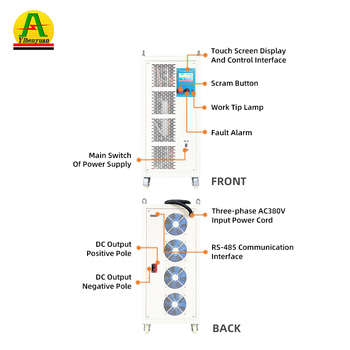
Fenvix anodizing rectifiers come standard with digital RS485 communication supporting standard Modbus-RTU protocol. Optionally, we provide Profinet, Profibus-DP, Ethernet/IP, or analog isolated 0–10V / 4–20mA interfaces. This allows full remote control over output voltage ramps, current density setpoints, process timer steps, bath temperature interlocks, and emergency stop circuits directly from Siemens, Schneider, or Allen-Bradley master PLCs.
What international certifications accompany our shipments to Iceland?
Because Iceland is an active member of the European Economic Area (EEA), all industrial equipment must satisfy strict European Union CE directives. Fenvix units ship with full CE declarations of conformity encompassing the Low Voltage Directive (LVD 2014/35/EU) and Electromagnetic Compatibility Directive (EMC 2014/30/EU), RoHS environmental compliance certificates, factory ISO 9001 QA documentation, and customized factory acceptance test (FAT) inspection reports signed by our chief test engineer.
What are the logistics, shipping routes, and lead times from Guangzhou to Reykjavík?
We provide full Incoterms flexibility: FOB Guangzhou/Shenzhen, CIF Reykjavík, or DDP directly to your workshop doors across Iceland. Maritime container transport is typically routed via major European transshipment hubs (Rotterdam or Hamburg) and connected directly to Icelandic domestic freight carriers (Eimskip or Samskip) into the Port of Reykjavík or Hafnarfjörður, with transit times averaging 35–45 days. Air cargo for compact units or emergency replacement components takes 5–8 business days via Keflavík International Airport (KEF).
Accelerate Your Anodizing Capabilities in Iceland
Need a custom 400V/50Hz water-cooled DC rectifier or automated pulse power supply configured for your tank dimensions? Connect with our senior power electronics team for technical sizing, wiring schematics, and factory-direct export quotations.