Engineered Aerospace & Industrial Power Solutions
Field-proven static frequency converters and heavy-duty rectifiers configured for extreme continuous loads, ultra-low harmonic distortion, and seamless hangar integration.
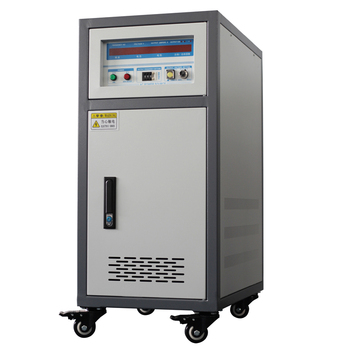
115V 400Hz Static Frequency Converter (15–300kVA)
- Input Frequency: 50Hz / 60Hz ± 5%
- Output Voltage: 115V / 200V AC ± 1%
- Output Frequency: 400Hz Fixed (±0.01Hz)
- THD (Linear Load): < 2.0%
- Topology: IGBT PWM Solid-State
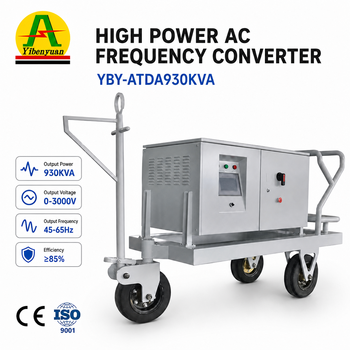
930kVA 3-Phase 400Hz Aircraft Ground Power Unit
- Rated Capacity: 930 kVA Heavy-Duty
- Nominal Output: 200V / 115V AC 3-Phase
- Overload Rating: 150% for 60s, 200% 10s
- Isolation: Galvanic Built-in Trans.
- Deployment: Apron Point-of-Use / Hangar
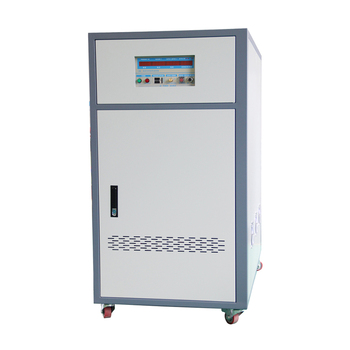
40kVA–500kVA Solid-State Static Converter
- Conversion Mode: 60Hz to 400Hz / 50↔60Hz
- Crest Factor: 3 : 1 Dynamic Ratio
- Response Time: < 2ms Step Change
- Interface: RS485 / Modbus RTU / SCADA
- Efficiency: > 92% at Rated Output
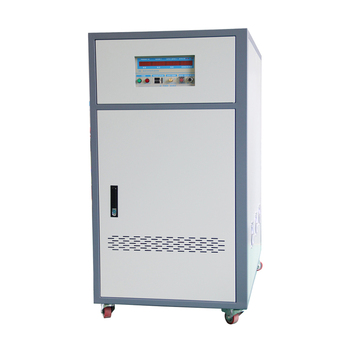
45kVA 400Hz Static Converter for Hangars
- Input Configuration: 480V/208V 3-Phase 60Hz
- Output Power: Single or 3-Phase 115V
- Acoustic Noise: < 62 dBA at 1 Meter
- Protection: IP21 / Optional NEMA 3R
- Applications: Regional Jet Avionics Bay
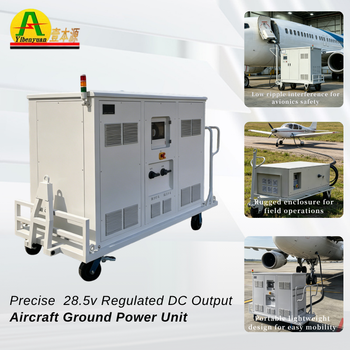
Mobile 28.5V DC Aircraft Ground Power Unit
- Continuous Current: 100A / 300A / 600A
- Engine Start Peak: Up to 2000A Surge (5s)
- Line Regulation: < ±0.5% Load Drift
- Chassis: Heavy-Duty Towable Trailer
- Standards: MIL-STD-704F Compliant
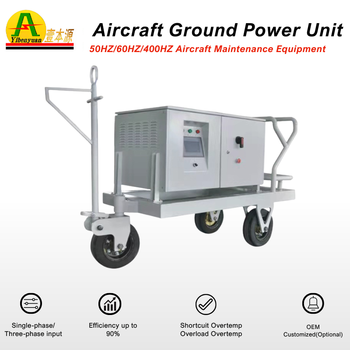
630kVA 400Hz High-Capacity Aviation GPU
- Power Capacity: 630 kVA True Continuous
- Output Adjustment: 115V–450V AC Program.
- Cooling Method: Forced Air with Heat Pipe
- Harmonic Filter: Active Filtering Stage
- Certification: CE, LVD, EMC, ISO 9001
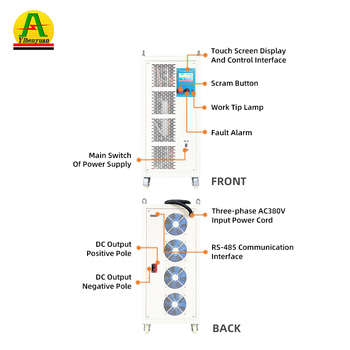
12V 4000A 48kW High-Frequency Rectifier
- Output Range: 0–12V / 0–4000A Continuous
- Regulation: Constant Voltage / CC Dual
- Efficiency: > 90% at Full Load
- Ripple Factor: < 2% RMS Low Noise
- Application: Hard Chrome, Zinc, Anodizing
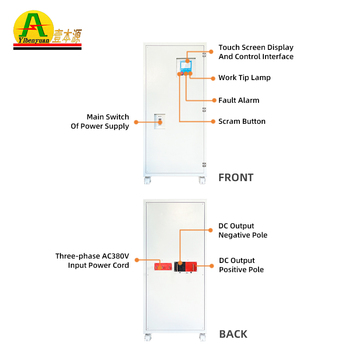
8000A 12V Water-Cooled DC Rectifier
- Output Rating: 12V DC at 8000 Amperes
- Cooling Design: Deionized Water Internal Loop
- Enclosure: Sealed IP54 Corrosion-Proof
- Automation: Profibus / RS485 / 4-20mA
- Application: Electrolysis, Continuous Strip
The Engineering Mechanics of 400Hz Solid-State Conversion
Modern aerospace systems rely heavily on 400Hz alternating current rather than conventional utility-grade 50Hz or 60Hz power. The underlying physics are straightforward: elevating the electrical operating frequency by a factor of nearly eight allows magnetic transformers, alternators, and fractional-horsepower servomotors onboard commercial, freight, and military aircraft to decrease their core volume and total mass by over 70%. In aerospace logistics centers like Louisville, Kentucky—where air cargo punctuality and turnaround speed govern global supply chains—clean, stable 400Hz ground power units (GPU) and static frequency converters are indispensable assets.
A static frequency converter (SFC) accomplishes frequency shifting entirely through solid-state power electronics, eliminating the rotational wear, oil degradation, acoustic cavitation, and bearing maintenance inherent to outdated rotary motor-generator (MG) sets. The conversion topology begins by drawing local grid electricity (typically 480V 3-phase, 60Hz in the United States) through a full-bridge Insulated-Gate Bipolar Transistor (IGBT) or Active Front End (AFE) rectifier. This stage converts AC power into an exceptionally stable, ripple-filtered direct current (DC) link. From there, a high-frequency Pulse Width Modulation (PWM) inverter bridge reconstitutes the DC voltage into a pure sinusoidal 115V/200V AC waveform operating at exactly 400Hz. Coupled with internal LC harmonic traps and heavy-duty galvanic isolation transformers, total harmonic distortion (THD) is maintained strictly below 2%, delivering laboratory-grade clean power to sensitive avionics, radar systems, and flight instruments.
Comparing Frequency Conversion Methodologies
For procurement officers, flight-line engineers, and plant managers across Jefferson County and surrounding regional airports, selecting the correct conversion architecture dictates operational expenditures, equipment longevity, and carbon footprints over decades of continuous hangar cycles.
| Performance Dimension | Fenvix Solid-State 400Hz SFC | Rotary Motor-Generator Sets | Diesel Mobile GPUs |
|---|---|---|---|
| Operating Efficiency | 92% to 94% (High part-load efficiency) | 75% to 82% (Severe losses when idling) | 35% to 42% (High fuel burn) |
| Acoustic Profile | < 65 dBA at 1 meter (Whisper quiet) | 85 to 95 dBA (Mandatory hearing protection) | 90 to 105 dBA (Extreme airfield noise) |
| Total Harmonic Distortion (THD) | < 2.0% Linear / < 3.0% Non-Linear | 3.0% to 5.0% (Prone to harmonic ringing) | 4.0% to 7.0% (Fluctuating under load) |
| Transient Recovery Speed | < 2 milliseconds (Microprocessor gating) | 200 to 500 milliseconds (Mechanical inertia) | 300 to 800 milliseconds (Governor lag) |
| Preventive Maintenance | Semi-annual filter check, zero lubrication | Frequent bearing repacking, brush replacement | Engine oil, filters, coolant, exhaust system |
| Hangar Emissions | Zero emissions (Environmentally neutral) | Zero direct emissions (Requires grease/disposal) | High CO₂, NOx, and diesel particulate soot |
Localized Application Scenarios Across Louisville & the Ohio Valley
Strategic deployment of 400Hz static power systems within North America's premier air freight hub and advanced industrial corridors.
Louisville Muhammad Ali International Airport (SDF) Cargo Aprons
Home to the Worldport air hub, Louisville handles massive nightly sorting cycles involving hundreds of widebody freighters (MD-11, B747-8F, B777F, A300-600). Fixed 400Hz point-of-use static converters eliminate the emissions and noise of idling auxiliary power units (APUs) during critical cargo transfers.
Benefit: Substantial reductions in jet-A fuel burn and compliance with municipal clean-air mandates.
Commercial MRO Hangars & Heavy Avionics Overhaul
Repair stations operating along Bowman Field (LOU) and regional maintenance hubs require ultra-clean, surge-free 115V/200V 400Hz power to calibrate inertial navigation platforms, digital cockpit instruments, fly-by-wire servos, and airborne weather radar suites without risk of electrical noise corruption.
Benefit: Transient-free switching prevents damaging sensitive semiconductor components.
Automotive & Heavy Appliance Surface Finishing
Louisville's extensive manufacturing legacy—including world-scale automotive assembly lines and appliance industrial parks—demands industrial DC rectifiers alongside precision frequency converters for testing multi-frequency export compressors and high-throughput robotic electroplating baths.
Benefit: Scalable water-cooled rectifier modules up to 15,000A ensure uniform metal plating thickness.
Emerging Industrial & Infrastructure Trends in Kentucky
How the green airport movement, cold-chain expansion, and Kentucky's battery corridor are transforming power infrastructure.
Decarbonization & Airport Gate Electrification
The Federal Aviation Administration (FAA) Voluntary Airport Low Emissions (VALE) program and regional sustainability compacts are aggressively incentivizing airports across Kentucky to install electric preconditioned air (PCA) and electric 400Hz ground power units at passenger boarding bridges and sorting fingers. Transitioning away from diesel ramp equipment prevents tons of carbon emissions annually, directly aligning with Louisville's Clean Energy Resolution goals.
The Rise of Advanced Air Mobility (AAM) & eVTOL Hubs
With Kentucky positioning itself as a central nexus for air freight, testing infrastructure for electric vertical take-off and landing (eVTOL) aircraft is rapidly scaling. These next-generation aircraft operate hybrid DC bus architectures (270V DC and 28.5V DC) alongside high-frequency AC subsystems. Modern solid-state converters provide the programmable versatility needed to test charging profiles and power converters under strict laboratory conditions.
EV Battery Corridor & Heavy Power Rectification
Central Kentucky has emerged as an epicenter for mega-scale electric vehicle battery gigafactories. These production ecosystems require heavy-duty DC power supplies for continuous electrode formation, cell aging, foil anodizing, and recycling hydrometallurgical electrolysis. Our industrial IGBT power designs transition seamlessly from aviation ramp power to high-amp continuous electrolytic processing.
Why Sourcing Directly from Our Factory Delivers Measurable ROI
Eliminate intermediary markups, streamline custom engineering adjustments, and secure ISO 9001 quality verified at every fabrication step.
ISO 9001 & TÜV Verified
Complete traceability from incoming raw copper stock to finished functional load testing. Third-party factory audit verification ensures industrial dependability.
In-House Sheet Metal & Busbars
Precision CNC shearing, punching, and milling machines cut lead times and guarantee robust chassis structures rated for harsh apron and plant conditions.
Zero MOQ Prototype Flexibility
We build single-unit engineering prototypes for custom avionics test benches as readily as multi-bay 930kVA apron power systems for large enterprise contracts.
100% Full-Load Burn-In
Every converter undergoes multi-hour oscilloscope, thermal camera, and resistive-inductive step-load burn-in testing prior to wooden export packaging.
Frequently Asked Questions by Louisville Engineers & Procurement Teams
Clear, direct answers regarding installation, utility compatibility, military standards, and logistics delivery to Kentucky.
Can your 400Hz frequency converters interface with standard American 480V/208V 60Hz utility grids?
Yes. All of our export static frequency converters and GPUs are engineered with input transformers and power stages designed specifically for North American electrical standards. We readily accommodate standard U.S. utility feeds including 480V 3-phase, 208V 3-phase, or 240V split-phase at 60Hz. Input voltage fluctuation tolerances of ±15% and frequency variations of ±5% are handled effortlessly without dropping output regulation.
Do these units satisfy military and civilian aerospace aviation standards (MIL-STD-704F & ARP5015)?
Our 400Hz static frequency converters and 28.5V DC GPUs are engineered to meet or exceed the performance parameters defined by MIL-STD-704F, SAE ARP5015, and ISO 6858. Critical attributes such as transient voltage recovery under 100% step-load changes (< 2ms recovery time), total harmonic distortion (< 2% linear), phase voltage balance under 30% unbalanced loads, and crest factor capability (3:1) are verified during pre-shipment factory testing with calibrated power analyzers.
How does a solid-state static converter handle high-inrush loads such as aircraft hydraulic pumps?
Aircraft induction motors and auxiliary hydraulic systems generate significant starting current surges, frequently reaching 300% to 500% of nominal rating. Our static converters are built with oversized IGBT power bridges and heavy-duty magnetic filtering. Standard units provide a 150% overload capability for 60 seconds and 200% for 10 seconds. For severe applications, custom high-surge configurations can be engineered to absorb dynamic inrush currents without triggering protective shutdown.
What is the delivery timeline and customs logistics process for shipping equipment to Louisville, KY?
Standard static frequency converters (15kVA to 100kVA) typically carry a manufacturing lead time of 2 to 3 weeks, while high-capacity units (300kVA to 930kVA) require approximately 4 to 5 weeks. We ship via major ocean freight lines to East Coast or Gulf ports with expedited bonded rail transport to Louisville intermodal depots, or via direct air cargo into Louisville Muhammad Ali International Airport (SDF). We support full DDP (Delivered Duty Paid) terms, handling all customs clearance, tariff documentation, and freight delivery directly to your facility door.
What after-sales commissioning and technical support do you provide to operators in Kentucky?
Every unit arrives with comprehensive wiring schematics, cable sizing calculators, terminal connection diagrams, and step-by-step commissioning guides. We provide direct remote engineering video sessions during installation to verify incoming utility connection, phase rotation, and initial load testing. Independent third-party on-site commissioning and emergency technical support agreements can also be coordinated for critical infrastructure projects.
Can your power supplies be configured for external remote monitoring (SCADA / Modbus)?
Absolutely. Units can be equipped with isolated RS485, RS232, CAN bus, or Ethernet (Modbus-TCP) communication interfaces. Operators can monitor phase voltages, line currents, frequency, operating temperature, fault codes, and runtime hours directly from central hangar control systems or building management automation software in real time.
Ready to Upgrade Your Louisville Power Infrastructure?
Whether you require a custom 400Hz static ground power converter for aircraft maintenance or a heavy-duty industrial DC rectifier for manufacturing, our engineering team will provide detailed CAD drawings, sizing calculations, and a direct factory quotation within 24 hours.
Send an Inquiry