Flagship
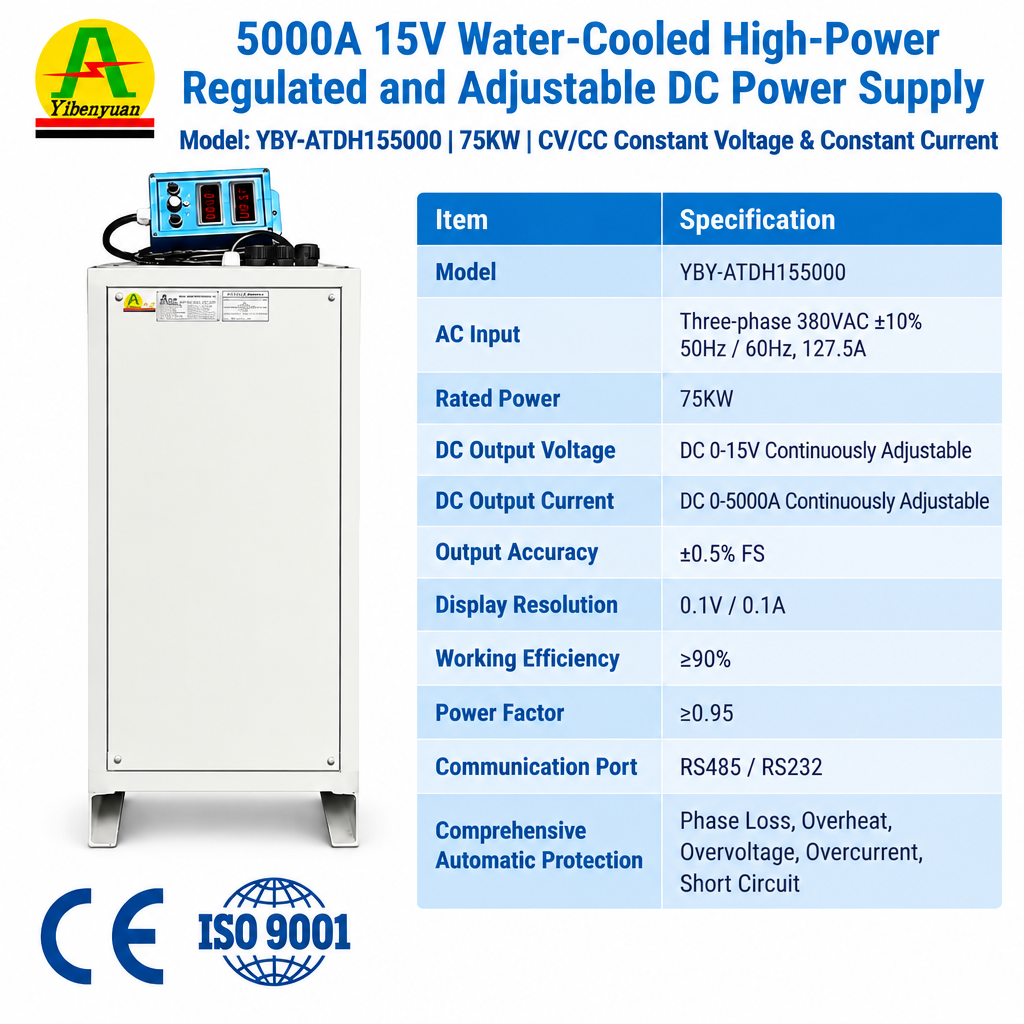
12V/15V 5000A–6000A 75kW Water-Cooled Electroplating Rectifier
- Voltage/Amperage:0–15V DC / Up to 6000A
- Cooling System:Internal Deionized Water
- Control Interface:Digital CC/CV RS485
Guangdong Fenvix Technology Co., Ltd. delivers high-efficiency DC power supplies engineered to minimize energy overhead, suppress ripple harmonics below <1%, and withstand severe corrosive processing plant atmospheres.
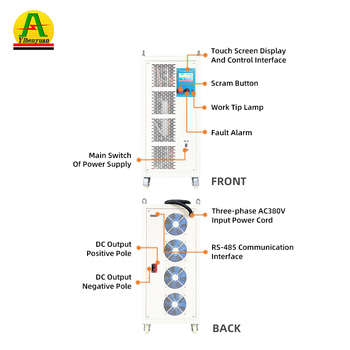
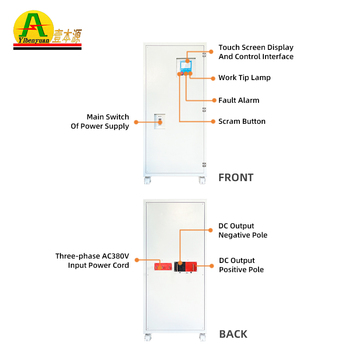
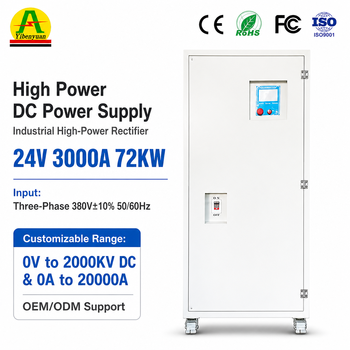
A comprehensive examination of power topologies, operational total cost of ownership (TCO), and system design protocols for global process engineers.
Traditional silicon-controlled rectifiers (SCR/Thyristors) utilize line-frequency (50/60Hz) phase gating, resulting in massive line transformers, significant harmonic distortion (low power factor), and elevated current ripple (typically >5%). In contrast, Fenvix Switch-Mode High-Frequency Rectifiers (SMPS) leverage insulated-gate bipolar transistors (IGBTs) operating at carrier frequencies between 20kHz and 50kHz. This design minimizes iron core footprint by up to 65%, maintains operational efficiency above 90%, and curtails line-side electrical noise.
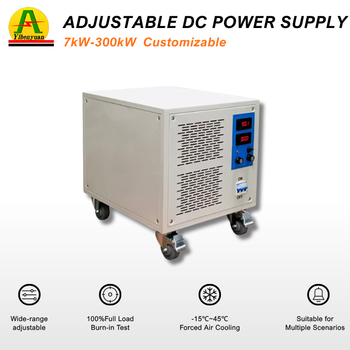
Managing heat flux across internal semiconductor junctions is critical for component longevity. Forced-air cooling represents an economical choice for clean room environments, benchtop testing, or capacities under 1,000A. However, in aggressive surface finishing, acidic anodizing lines, and multi-thousand-ampere smelting setups, air blowers ingest corrosive airborne acid mists. Fenvix closed-loop water-cooled rectifiers isolate internal switching electronics inside sealed IP54/NEMA 4X enclosures, utilizing electrolytic copper chill plates that deliver zero ambient air ingestion and continuous 24/7 thermal stabilization.
Current ripple below 2% RMS is required to eliminate lattice micro-cracking and achieve atomic-level grain uniformity across electroplated nickel, decorative chrome, hard anodized layers, and high-density interconnect (HDI) copper traces. Our switch-mode pulse-width modulated (PWM) regulation ensures ripple stays strictly beneath <1% over the entire adjustment bandwidth (0–100%). This precise wave-shape regulation lowers bath additive consumption, prevents metal nodule formation, and guarantees repeatable micro-hardness values across structural substrates.
Compare operational parameters across standard industrial topologies to optimize capital expenditures (CAPEX) and recurring operational expenditures (OPEX).
| Application Category | Standard Configuration | Cooling Method | Ripple Factor | Communication & Controls | Primary Process Benefit |
|---|---|---|---|---|---|
| Industrial Electroplating (Zn, Ni, Cu, Cr) | 6V–24V DC / 1,000A–15,000A | Deionized Water-Cooled | < 1% RMS | Modbus RTU / 0–10V / 4–20mA | Uniform grain boundary structure; minimal plating bath additives required. |
| Aluminum & Titanium Anodizing | 12V–150V DC / 300A–3,000A | Air / Closed-loop Water | < 2% RMS | Multistep Voltage & Current Ramp | Eliminates thermal burning on hard anodized film layers (Type III). |
| Electrophoretic Paint (E-Coat) | 100V–400V DC / 20A–150A | Forced Air Cooled | < 0.5% RMS | Soft-Start Time Regulated | Flawless paint adhesion without pinholes, orange peel, or film rupture. |
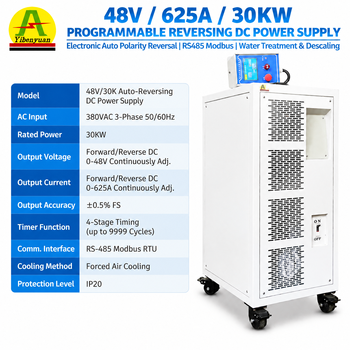
| Water Descaling & Treatment | 24V–48V DC / 100A–1,000A | Air / Water Cooled | < 3% RMS | Microsecond Auto Polarity Reversal | Self-cleaning electrolytic cell anodes; continuously dissolves scale buildup. |
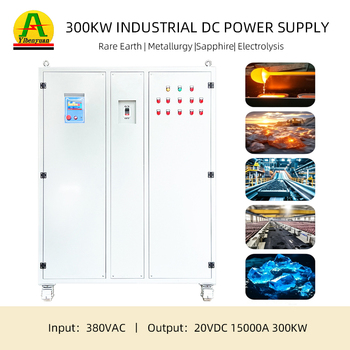
| Continuous Metal Refining / Smelting | 15V–60V DC / 5,000A–15,000A+ | Closed-Circuit Water | < 1% RMS | Industrial Ethernet / Profinet / RS485 | Sustained 24/7 continuous operation without thermal throttling or derating. |
Strategic engineering shifts driving global supply chain procurement decisions through 2026–2030.
Silicon Carbide (SiC) power MOSFETs and diodes are systematically replacing conventional silicon components. By enabling switching frequencies beyond 100kHz, SiC power blocks reduce heat losses by 30%, shrink internal magnetic inductors, and tolerate junction temperatures exceeding 175°C. For industrial plants operating multi-megawatt facilities, switching to SiC-assisted power rails translates directly to tens of thousands of dollars saved annually in baseline grid electricity.
Monolithic, single-point transformer cabinets are yielding to modular drawer-type parallel architectures with hot-swappable N+1 redundancy. If an individual power module encounters an unexpected over-current fault on an operational plating or electrolysis line, the surviving parallel modules instantly pick up the load margin without dropping the batch. Plant maintenance teams can pull and service a single module without cutting plant utility mains or halting production.
Procurement teams increasingly require native Industrial IoT connectivity (Modbus-TCP, Ethernet/IP, Profinet) built straight into the rectifier primary controller. Real-time telemetry monitoring input AC harmonic distortion, individual copper busbar thermal sensors, water chiller flow rates, and DC current delivery enables factory SCADA integration. Machine learning algorithms process this data stream to predict capacitor degradation and busbar fouling well before unscheduled downtime occurs.
By producing our structural enclosures, copper busbars, and wiring harnesses internally, Fenvix eliminates sub-tier lead time volatility while enforcing strict ISO 9001 quality gates.
Laser plate shearing, CNC punching, milling, drilling, and tapping managed entirely inside our Guangdong production facilities.
Stringent incoming component screening, PCB conformal coating verification, and finished-assembly dielectric insulation checks.
Every industrial rectifier undergoes continuous full-capacity thermal burn-in utilizing dynamic resistive and inductive load banks.
Documented CE, RoHS, LVD, and EMC conformity backed by on-site factory verification from TÜV Rheinland.





Direct answers from our senior electrical engineering team to help you specify, configure, and install heavy-duty DC rectification systems.
Consult directly with our Guangdong senior electrical power engineers. We will analyze your duty cycle, tank chemistry, and interface requirements to return a fully sized CAD drawing and quotation within 24 hours.