Engineering Whitepaper: Custom Industrial Rectifier Topologies & Precision Metal Deposition
In modern industrial surface finishing, high-reliability electrodeposition, and continuous coil anodizing, the rectifying unit is no longer a rudimentary step-down transformer with a selenium or silicon stack. It is the fundamental core determining coating micro-hardness, corrosion boundaries, pore diameter, layer throwing power, and metallurgical grain consistency. As electroplating chemistry tightens tolerances down to micro-inch levels—particularly in advanced automotive components, semiconductor lead-frames, and military airframe landing gears—the requirement for ultra-low RMS ripple factors and millisecond-level step response has driven a sweeping technological migration from legacy Thyristor (SCR) architectures to Insulated Gate Bipolar Transistor (IGBT) high-frequency switch-mode power supplies (SMPS).
Switch-Mode IGBT Architecture vs. Legacy Silicon Controlled Rectifiers (SCR)
The technical shift from SCR to high-frequency IGBT conversion eliminates the deep low-frequency current oscillations native to 50Hz/60Hz mains transformer rectification. In traditional 6-pulse or 12-pulse SCR systems, the current output exhibits a ripple spectrum between 5% and 15% without heavy, space-consuming LC chokes. This harmonic distortion directly disrupts the electrochemical double layer (Stern layer) at the cathode-electrolyte boundary, accelerating anode passivation, increasing hydrogen embrittlement risks in ultra-high-strength steels, and causing uneven current density distribution across high-aspect-ratio geometries.
Fenvix switch-mode rectifiers operate at switching frequencies ranging from 20kHz to 50kHz. High-frequency pulse-width modulation (PWM) through high-speed trench-gate IGBTs cuts current ripple down to ≤ 1% to 2% RMS throughout the full nominal range. The direct operational benefit is an immediate improvement in deposition quality: denser crystallization structures, reduced internal mechanical stress in hard chrome deposits, superior luster in nickel-chrome lines, and drastic reductions in precious metal bath consumption (gold, platinum, silver, rhodium) by avoiding over-plating peaks.
| Topological Parameter |
Traditional Thyristor (SCR) |
Fenvix High-Frequency IGBT SMPS |
Operational Impact |
| Switching Frequency |
50 Hz – 300 Hz Line Frequency |
20,000 Hz – 50,000 Hz |
Near-zero ripple, smaller footprint |
| Current Ripple (RMS) |
5% – 15% (Requires Large Filter) |
≤ 1% – 2% Standard Across Range |
Eliminates burning, yields uniform grain |
| Conversion Efficiency |
68% – 78% (Significant Heat Loss) |
90% – 93% Full Load |
Lowers direct kilowatt-hour operating cost |
| Dynamic Step Response |
100 ms – 300 ms Delay |
≤ 5 ms Complete Settling |
Instantly corrects tank bath loading shifts |
| Volumetric Weight / Size |
Extremely Heavy, Transformer Bound |
Up to 65% Reduction in Mass |
Facilitates line-side mezzanine mounting |
Thermal Dissipation Protocols: Liquid Water Cooling vs. Direct Forced Air
A primary failure mode in electroplating environments stems from thermal stress compounded by environmental chemistry. Acid mists containing hydrochloric, sulfuric, or chromic vapors rapidly degrade standard internal electronics. Hence, thermal engineering is just as critical as electrical circuit stability.
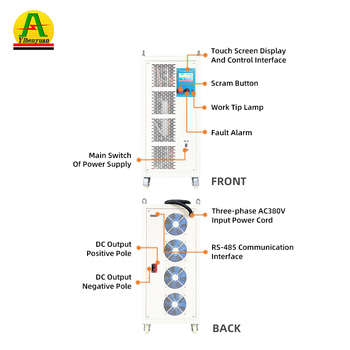
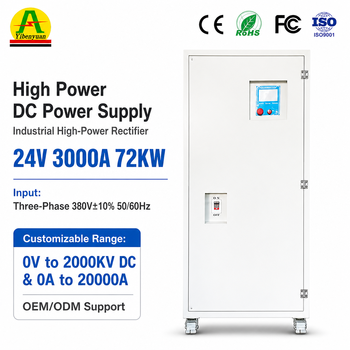
Forced-Air Dissipation: Utilizes isolated structural airflow ducts where internal wind pathways are separated from sensitive digital controller motherboards. Copper heat sinks are treated with anti-corrosion clear coatings, and fans are equipped with sealed IP55 bearings. Air cooling provides ease of installation for facilities where cooling water circuits are unavailable, proving economical for small-to-medium ratings up to 3000A.
Closed-Loop Water Cooling: Mandatory for continuous, multi-shift production plants running 5000A to 15,000A+ capacities. Our high-conductivity extruded pure-copper cold plates directly interface with the collector plates of IGBT modules, fast-recovery diodes (FRD), and nanocrystalline transformer cores. Because the cabinet can be fully enclosed to IP54 or IP56 standards, corrosive atmospheric ambient air is completely isolated from internal power electronics, prolonging operational lifespans beyond 10–15 years in severe pickling and plating workshops.
Future Sourcing Trends in High-Volume Surface Engineering
Global industrial procurement leaders are systematically pivoting towards four distinct technical parameters when awarding multi-tank rectifier packages:
1. Industry 4.0 Digital Network Integration: Legacy analog potentiometers (0-10V or 4-20mA knobs) are rapidly being decommissioned in favor of isolated RS-485 Modbus-RTU, Profinet, and Ethernet/IP protocols. Centralized Supervisory Control and Data Acquisition (SCADA) platforms require second-by-second amp-hour metering, cathode current density logging, and real-time fault diagnostic alerts to uphold aerospace NADCAP and automotive IATF 16949 production traceabilities.
2. True N+1 Modular Hot-Swappable Architectures: Modern continuous reel-to-reel plating plants cannot absorb the catastrophic production loss associated with a single cabinet outage. Sourcing specifications now emphasize multi-module architectures where sub-units dynamically balance current. If a single module encounters an anomaly, the remaining modules dynamically absorb the load without interrupting the chemical process cycle.
3. Advanced Pulse & Periodic Reverse (PR) Current Control: Periodic reverse plating—crucial for descaling, copper plating in microvias of high-density interconnect (HDI) PCBs, and hard anodizing—requires rapid microsecond-range polarity inversion. Microprocessor-driven H-bridge topologies allow custom forward-pulse, reverse-pulse, and duty-cycle control, improving step coverage in difficult recessed blind holes.