75kW CV/CC
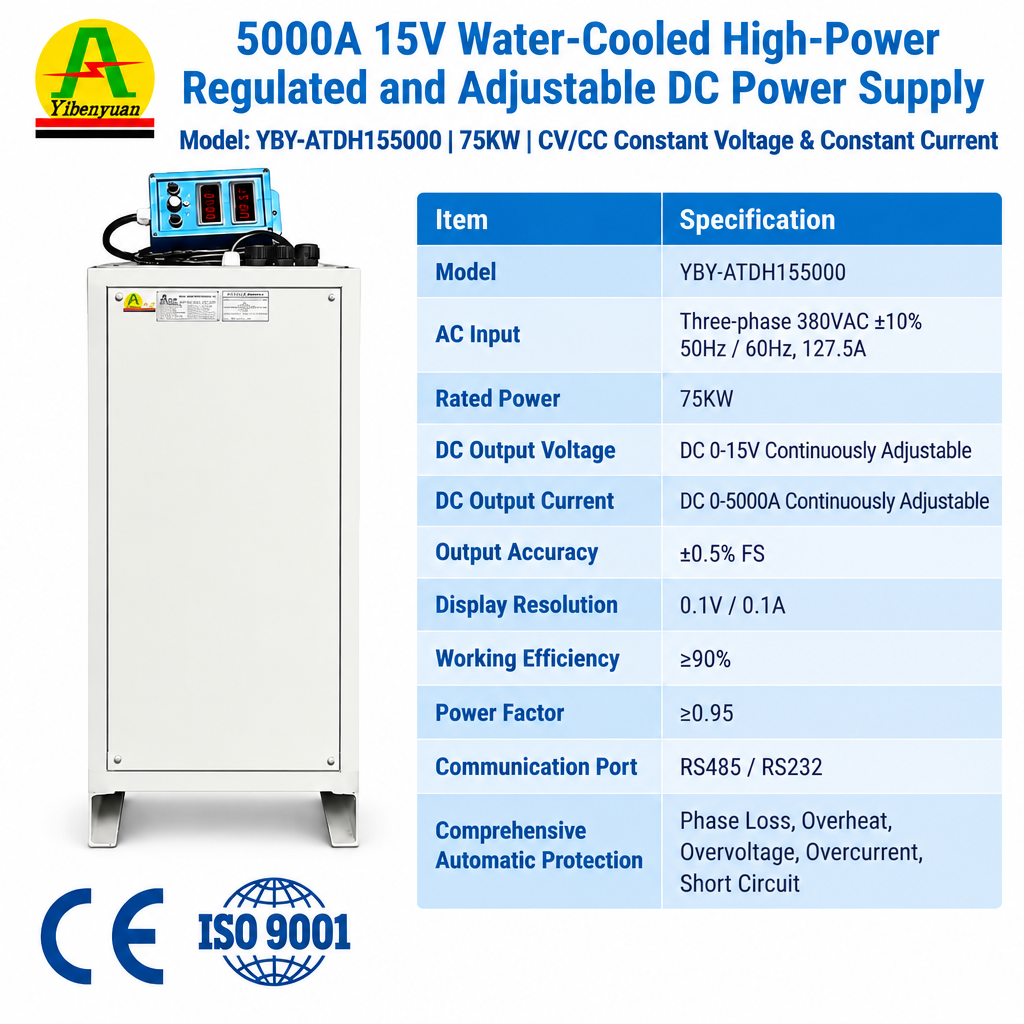
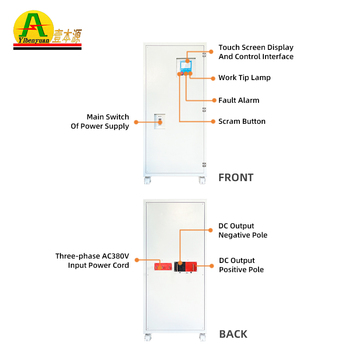
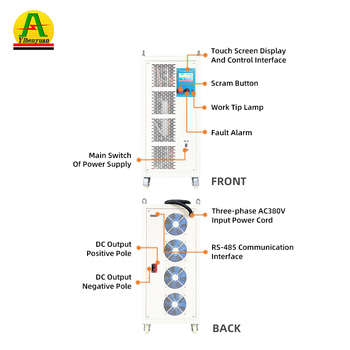
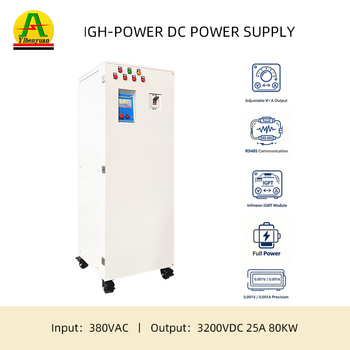
12V-15V 5000A-6000A 75kW Water-Cooled DC Rectifier
- TopologyIGBT High-Freq
- Output Range12V/15V | Up to 6000A
- Cooling SystemDeionized Water Loop
- InterfaceRS485 / Modbus RTU
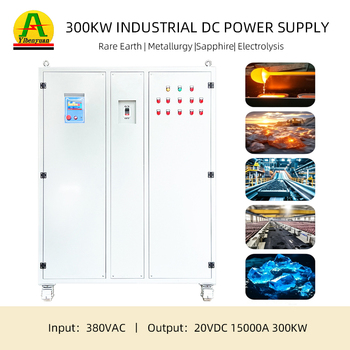
Direct OEM/ODM industrial-grade architectures manufactured to tight tolerance limits. Scalable configurations from laboratory pulsed validation to 15,000A continuous plant deployment.
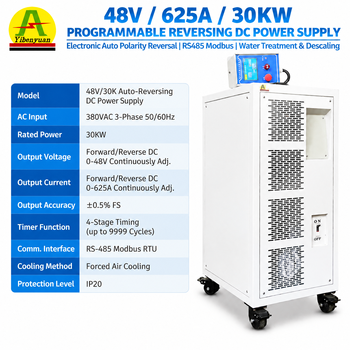
Why modern electrochemistry, semiconductor wafer deposition, and specialized surface engineering are transitioning from continuous direct current to advanced periodic pulse reverse architectures.
| Operating Attribute | Legacy SCR / Thyristor Rectifier | Standard High-Frequency Switch Mode | Advanced OEM DC Pulse Power Supply (IGBT/SiC) |
|---|---|---|---|
| Current Modality | Continuous Analog DC (High Ripple >5%) | Smooth Steady-State DC (Ripple <2%) | Unipolar, Bipolar, & Modulated Asymmetric Pulse |
| Boundary Diffusion Layer | Thick, depleted ion concentration boundary | Standard steady-state mass transport | Constantly replenished ions during T-OFF micro-intervals |
| Grain Structure & Density | Coarse crystal grains; micro-porosity risks | Uniform standard crystalline morphology | Nanocrystalline, high hardness, zero-crack micro-matrix |
| Throwing Power & Aspect Ratio | Poor step coverage in deep micro-vias (< 4:1) | Moderate throwing efficiency (up to 6:1) | Exceptional deep blind-hole penetration (> 12:1 ratio) |
| Energy Consumption Footprint | High thermal loss; low PF (~0.70) | Moderate efficiency (~85-88%) | ≥ 92% Efficiency; Power Factor > 0.95 with Active PFC |
In classical electrodeposition, continuous direct current generates an ion-depletion boundary layer at the cathode interface. This limits throwing power, induces macroscopic dendrite formations, and slows plating speed. Custom OEM DC Pulse Power Supplies mitigate this physical bottleneck by dividing electrical delivery into distinct, microsecond-accurate intervals: pulse-on time (TON), during which ions rapidly deposit under concentrated electrical fields, and pulse-off time (TOFF), which allows metallic ions in the bulk electrolyte to diffuse back to equilibrium without forming hydrogen gas pits or burnt nodules.
When integrating Periodic Pulse Reverse (PPR) topologies, where an ultra-short anodic current pulse strips microscopic asperities immediately after cathodic deposition, microscopic surface uniformity achieves nanoscale perfection. This precision is compulsory for multi-layer semiconductor interconnects, medical stents, turbine coating thermal barriers, and aerospace titanium anodizing.
Engineering and purchasing directors must evaluate high-power conversion hardware through the lens of long-term lifecycle ownership, operational resilience, and environmental ESG compliance.
Global procurement teams are mandating SiC MOSFET architectures over traditional silicon IGBT modules. SiC halves thermal dissipation losses, operates at switching frequencies above 100 kHz, and reduces cabinet spatial footprints by up to 40% in automated chemical line designs.
Forward-thinking enterprises have ceased evaluating power suppliers solely on initial ex-factory pricing. An efficiency difference of merely 4% in a continuous 300kW electrolytic facility translates to tens of thousands of dollars saved annually in baseline grid draw and HVAC chill plant operation.
Standalone analog knobs are obsolete in modern tier-1 supply chains. Today's RFP specifications require integrated Profinet, EtherCAT, and Modbus TCP interfaces for real-time waveform recording, predictive thermal anomaly alerts, and complete batch tracing down to single microsecond pulses.
Unplanned downtime inside high-volume continuous electrodeposition or semiconductor fab bays leads to immediate batch scrapping. Sourcing criteria heavily prioritize sub-rack modular designs where a single faulted module can be swapped under operational load without terminating active processing.
Procurement teams operating in coastal or chemical environments now refuse standard vented electrical cabinets. The trend strongly favors sealed IP54 to IP66 dual-circuit liquid-to-liquid heat exchangers that completely isolate internal power electronics from airborne acid mists and chlorides.
As modern processes evolve, standard catalogue ratings of 12V or 24V fail to deliver optimized current densities. High-efficiency operations require OEM factories capable of engineering asymmetric profiles, unusual rail voltages (such as 37.5V or 84V), and synchronized multi-channel pulses.
An engineering forecast of how wide-bandgap semiconductors, digital twin modeling, and active harmonic mitigation are redefining power conversion standards.
Next-generation pulse power converters are moving beyond conventional microsecond transitions into the nanosecond switching domain (< 100 ns). This steep dV/dt profile stimulates non-equilibrium plasma discharges and unlocks advanced atomic-layer electro-machining without micro-cracking.
Replacing traditional DSP microcontrollers with ultra-fast Field Programmable Gate Arrays (FPGA) allows instantaneous microsecond compensation against electrolytic bath load swings, effectively preventing anode passivization and eliminating harmful localized micro-arcing events.
Thermal dissipation limits are being shattered by integrating direct 3D-printed micro-channel cold plates beneath primary switching dies. This eliminates layers of thermal grease, optimizes heat-flux transfer, and guarantees stable operating parameters in tropical ambient conditions.
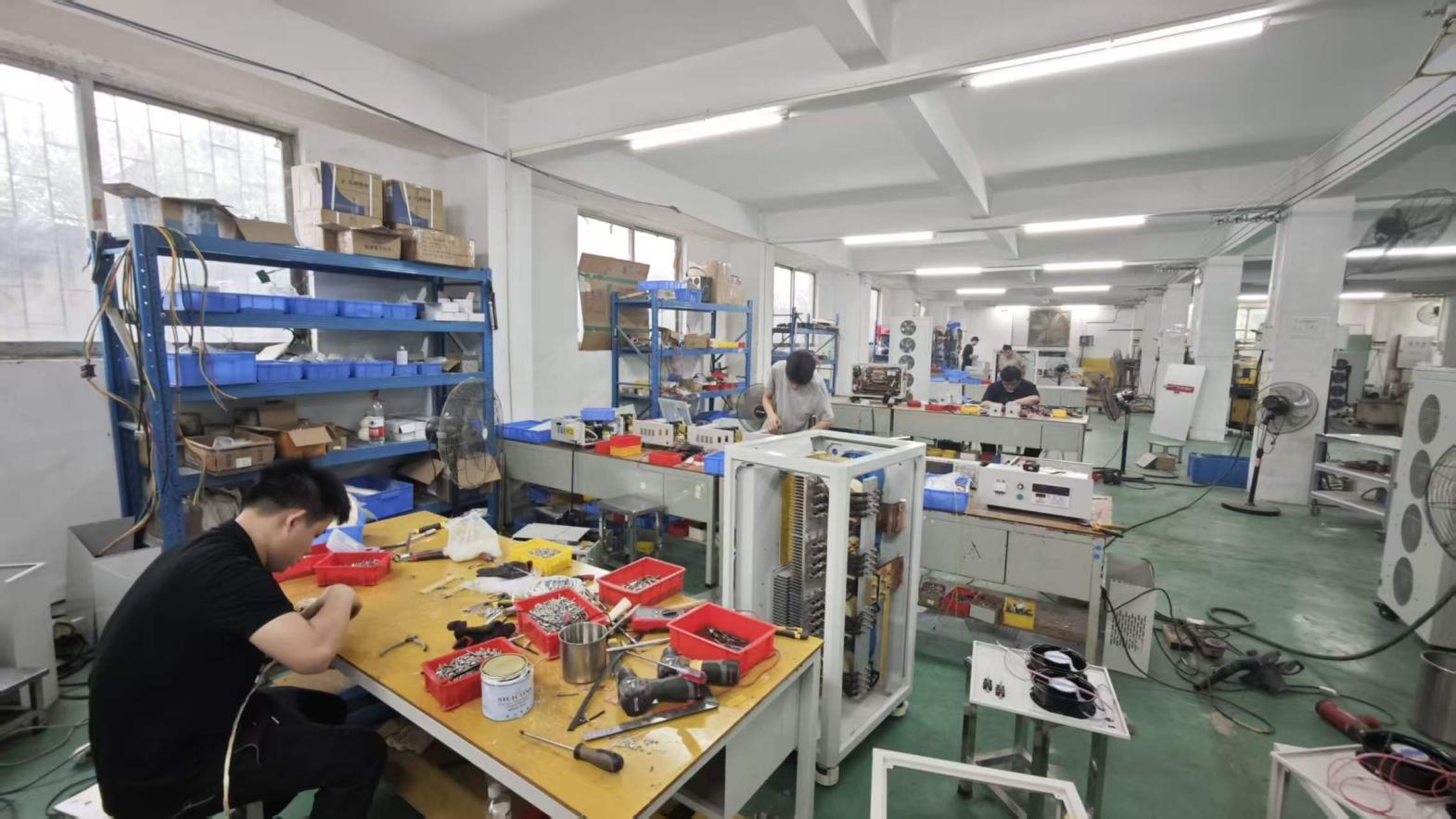
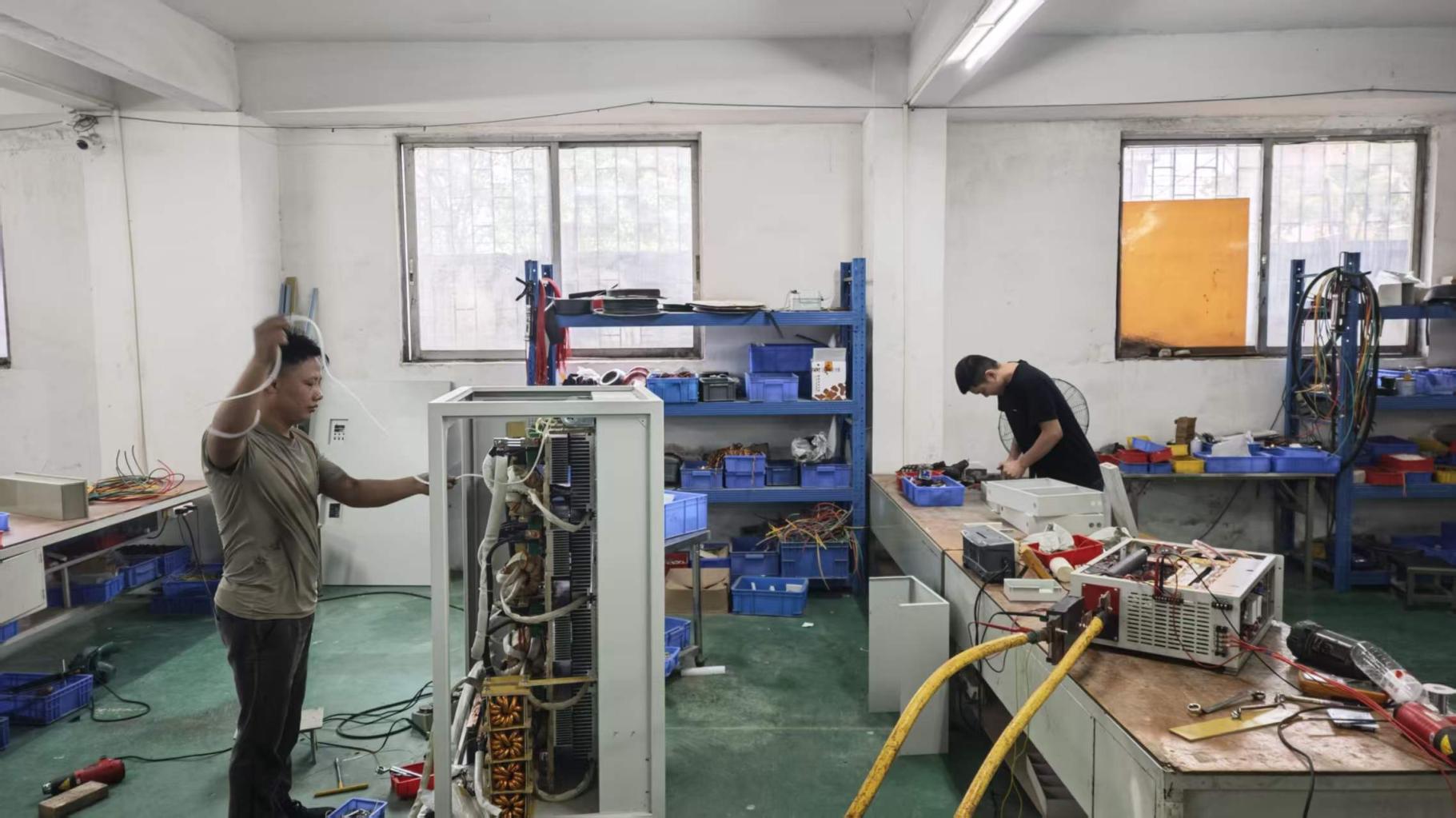
Founded in 2013 in Guangzhou, Guangdong, Fenvix specializes in solving non-standard industrial power challenges. No catalogue compromises, no trading middleman markup, and complete vertical manufacturing control.
Decade-plus mastery over high-current, high-voltage, and specialized solid-state frequency conversion applications worldwide.
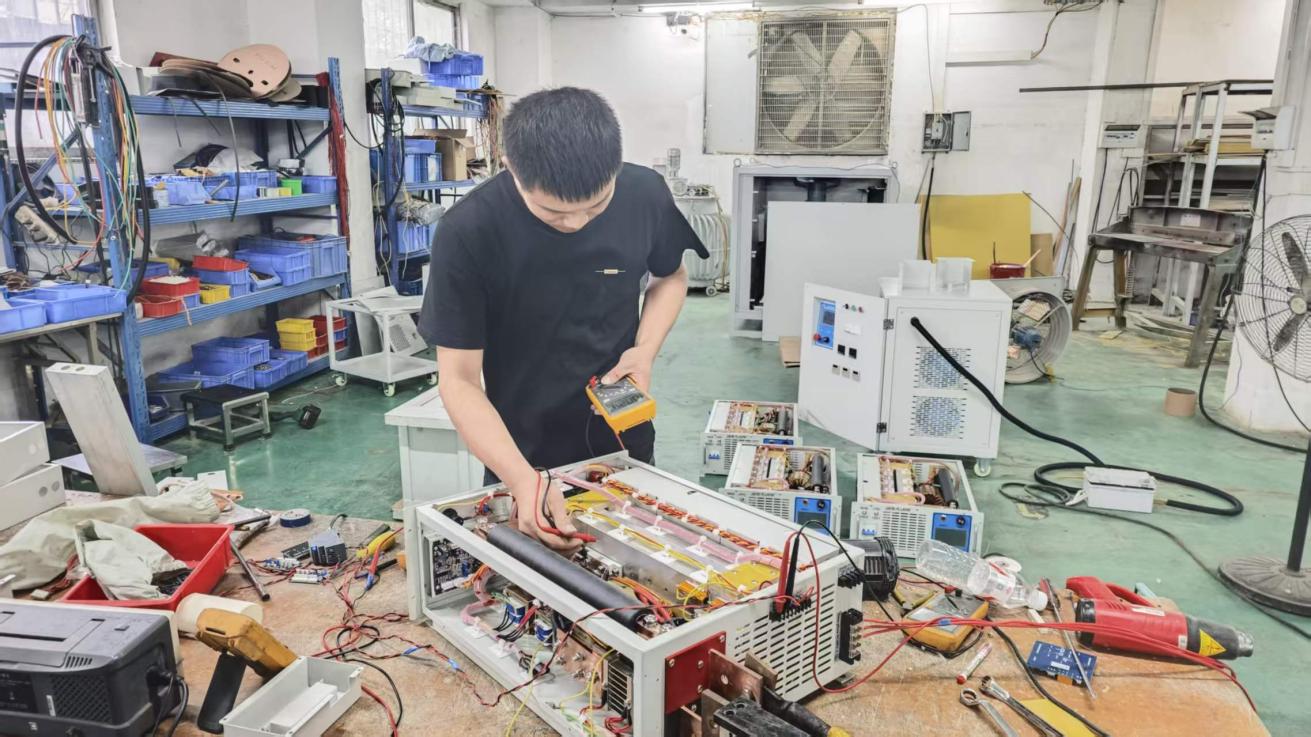
Complete in-house mechanical fabrication: plate shearing, CNC punching, milling, drilling, busbar tapping, and wiring.
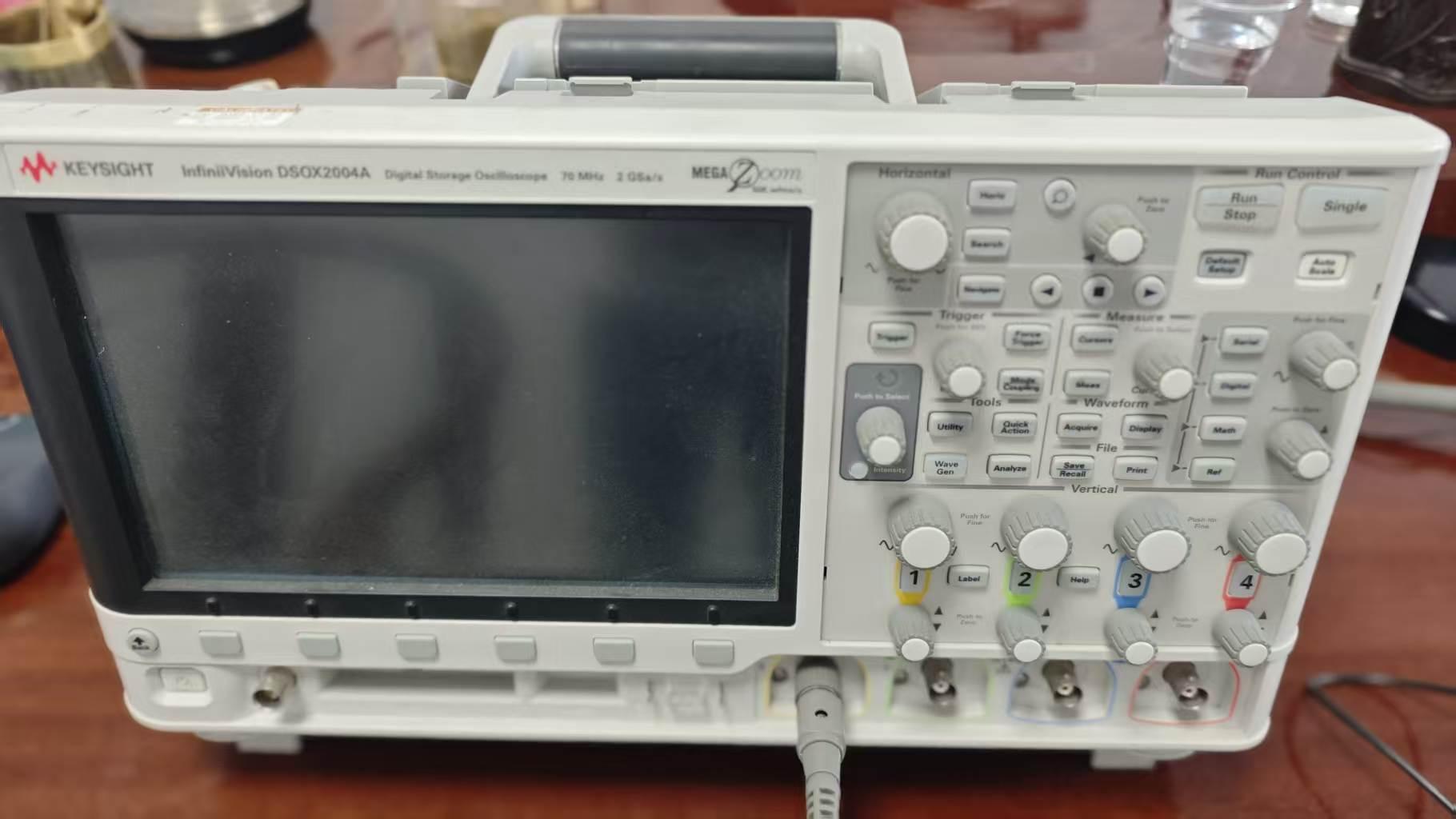
Internationally certified factory verified on-site by TÜV Rheinland. Full compliance with CE, RoHS, LVD, and EMC directives.
Engineering pilot-scale 1-unit prototypes with the identical quality rigor and inspection transparency as 500-unit continuous orders.
Crucial configuration points, sizing parameters, and international trade governance evaluated by procurement officers before contract sign-off.
Consult directly with our Guangdong factory application engineers. We evaluate your load curves, bath dimensions, and duty cycles to deliver customized CAD drawings, electrical schematics, and firm quotations within 24 hours.