High-Capacity Industrial AC to DC Rectifiers
Custom-fabricated rectifiers engineered with advanced IGBT bridge topologies, continuous variable voltage-current regulation, and modular multi-phase cooling architectures.
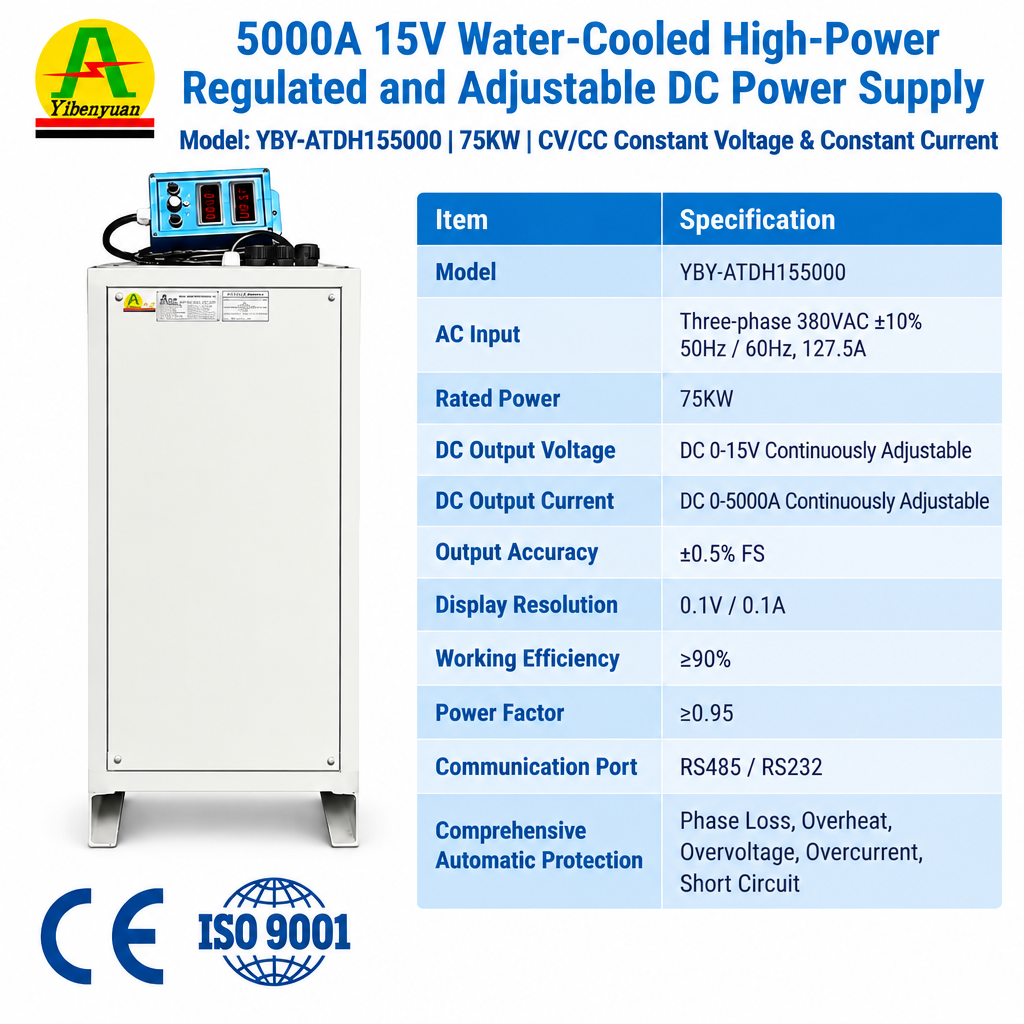
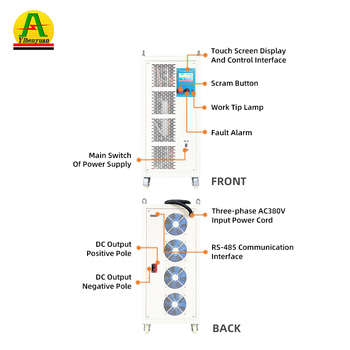
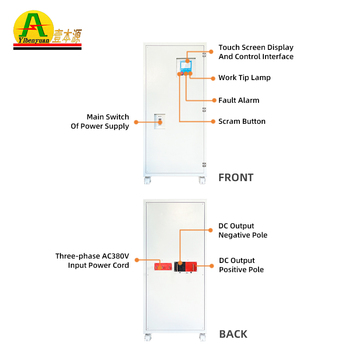
12V/15V 5000A-6000A 75kW Water-Cooled Rectifier
- Topology: High Frequency IGBT
- Cooling: Deionized Closed Loop
- Control: CC / CV Digital Display
12V 4000A 48kW High Frequency Plating Rectifier
- Efficiency: ≥ 90% at Full Load
- Ripple Factor: ≤ 2% RMS
- Applications: Zinc, Copper, Nickel Lines
8000A 12V Heavy-Duty Water-Cooled Galvanizing Rectifier
- Output Current: 0 - 8000A Continuous
- Protection: Overheat / Short / Phase Loss
- Interface: RS485 Modbus-RTU
100A-3000A Programmable Anodic Oxidation Rectifier
- Output Voltage: 12V / 18V / 24V / 60V
- Ramping: Multi-stage Soft Start
- Process: Hard & Sulfuric Anodizing
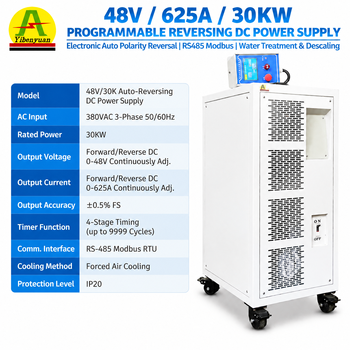
48V 625A 30kW Polarity Reversing Descaling Rectifier
- Reversing Cycle: Programmable 1s - 999m
- Cooling Mode: Forced Air Exhaust
- Duty Cycle: 100% 24/7 Heavy Load
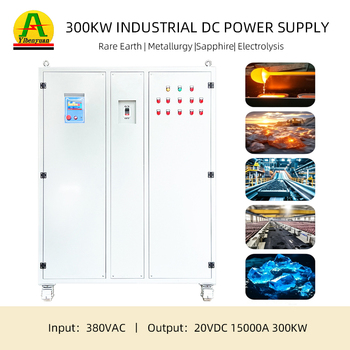
300kW 20V 15,000A Heavy-Duty Electrolysis Rectifier
- Current Rating: Up to 15,000A DC
- Busbar Link: Solid T2 Oxygen-Free Copper
- Enclosure: Anti-Corrosion C3/C4 Seal
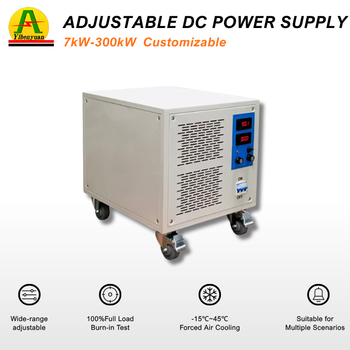
800V 50A 20kW Programmable EV Testing DC Power Supply
- Output Range: 0 - 800V / 0 - 50A Step
- Slew Rate: Fast Transient Dynamic Step
- Standards: CE, EMC, LVD Verified
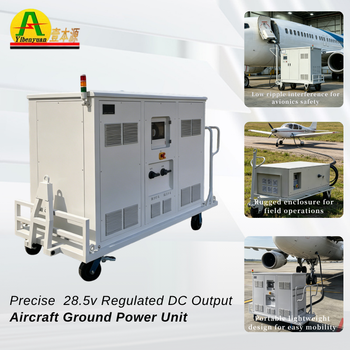
Portable 28.5V DC 100A-500A Aviation Ground Power Unit
- Starting Peak: Up to 2000A Overload
- Portability: Heavy-Duty All-Terrain Wheels
- Compliance: ISO 6858 & Mil-Std Specs
Engineering Authority: Sourcing Industrial AC to DC Rectifiers from China
The global electro-intensive manufacturing sector is undergoing an operational overhaul. Industrial AC DC rectifiers—vital components bridging incoming medium-to-low voltage AC grids (220V, 380V, 415V, 480V 3-phase) with sensitive direct current electrochemical and electromagnetic processes—determine not only final finish quality but also annual multi-megawatt operating expenditures. Sourcing engineered rectifiers from reputable China suppliers requires evaluating solid-state power semiconductor topologies, copper busbar thermodynamics, harmonic mitigation schemes, and operational durability under aggressive acid-mist or humid conditions.
Historically, industrial facilities relied heavily on thyristor (SCR) controlled power systems. While structurally robust under surge conditions, silicon-controlled rectifiers carry major operating handicaps: typical electrical efficiencies stagnating around 70% to 82%, massive cabinet footprints, heavy copper-wound line-frequency transformers, and poor line power factors (λ < 0.75) that incur utility penalty fees. Today, high-frequency switch-mode power supplies (SMPS) utilizing insulated-gate bipolar transistors (IGBTs) have superseded traditional silicon assemblies across precision electroplating, aluminum anodizing, industrial water treatment, and laboratory burn-in sectors.
Comparative Technical Benchmarks: Silicon (SCR) vs. High-Frequency IGBT Switching
For international technical directors and plant procurement managers, discerning the balance between switchgear conversion topologies is essential when evaluating initial capital expenditure versus Total Cost of Ownership (TCO). High-frequency IGBT rectifiers modulate energy at frequencies spanning 10kHz to 40kHz, slashing the required magnetic core volume of the step-down transformers while shrinking output ripple from 5% down to less than 1-2% without relying on enormous passive filtering chokes.
| Evaluation Parameter | High-Frequency IGBT Switch-Mode | Traditional Thyristor (SCR) Unit | Impact on Process Engineering |
|---|---|---|---|
| Conversion Efficiency | 88% - 93% across varied loads | 72% - 82% (drops drastically at low loads) | Saves 10%-20% on grid power; lower plant cooling loads |
| Current Ripple (<% RMS) | ≤ 1% to 2% across full dynamic range | 5% to 8% (requires massive inductors) | Denser microcrystalline metal finish; eliminates burnt edges |
| Line Power Factor | ≥ 0.92 to 0.95 without correction | 0.65 to 0.78 (phase-controlled delayed firing) | Averts utility low-cos-phi fines; lowers kVA rating demand |
| Dynamic Response Speed | < 50 microseconds (μs) | 10 to 20 milliseconds (1/2 grid cycle) | Precise control during bath immersion and flash strikes |
| Physical Footprint & Weight | Compact modular design (1x volume factor) | Heavy oil/air cabinet (3.5x - 4x volume factor) | Allows tank-side installation, drastically shortening DC bus runs |
Future Sourcing & Procurement Trends in Industrial Rectification (2025-2030)
The manufacturing landscape for power electronics is evolving along distinct technical pathways. Buyers assessing long-term investments must navigate several core procurement dynamics:
Wide-Bandgap (SiC) Adoption
Silicon Carbide (SiC) MOSFETs are actively shifting industrial power conversion. With thermal endurance surpassing silicon and minimal switching losses at frequencies above 60kHz, SiC yields power converters with 96%+ efficiency, cutting size by another 30% for ultra-dense containerized plating plants.
Fieldbus & IIoT Smart Integration
Discrete analog 0-10V or 4-20mA control loops are rapidly migrating toward digital protocols: Profinet, EtherCAT, and Modbus-TCP. Facilities demand real-time telemetry on ripple, temperature, and IGBT health to fuel predictive maintenance algorithms.
Zero-Loss Modular Redundancy
Rather than single-cabinet failures halting plating lines, enterprise buyers increasingly mandate N+1 parallel modular architectures. If one 1000A submodule trips, hot-swappable arrays pick up the load without breaking the continuous current loop, averting batch scrap.
Technological Trends: Closed-Loop Water Cooling vs. Corrosive Air Intake
One of the primary failure modes for plating and electrolysis rectifiers in chemical atmospheres is fan-driven ambient cooling. Corrosive airborne contaminants—including hydrochloric, sulfuric, and chromic acid vapors—erode exposed transformer laminations, dry solder joints, and cause catastrophic flashovers between IGBT collector-emitter junctions. Forward-looking procurement programs increasingly specify isolated, water-cooled enclosures (IP54 / NEMA 4X equivalent).
In closed-loop deionized liquid systems, heat generated across power semiconductor bases, ultrafast recovery diodes, and high-frequency ferrite transformers is conducted directly to pure copper cold plates. Heat is rejected via external heat exchangers, eliminating external air intake into high-voltage electronics. This architecture quadruples Mean Time Between Failures (MTBF) and stabilizes junction temperatures during 24/7/365 peak operations.
Factory Selection Checklist: How to Qualify a Chinese Rectifier Manufacturer
Procuring capital power equipment directly from China presents cost and lead-time advantages, but engineering validation must govern supplier evaluation. When reviewing bids, overseas sourcing teams must verify three structural factors:
1. Mechanical In-House Fabrication & Copper Busbar Processing: Specialized manufacturers like Guangdong Fenvix Technology maintain in-house sheet-metal processing, including plate shearing, punching, milling, drilling, and tapping machines. They process their own heavy-duty T2 oxygen-free copper busbars to ensure low resistance contact. Trading entities and low-tier assemblers outsource cabinet construction, resulting in compromised busbar cross-sections, undersized thermal mass, and high contact resistance that causes busbar burnout under high amperage loads.
2. Oscilloscope Waveform & Full-Load Burn-In Documentation: Top-tier manufacturers run every completed high-current rectifier unit through full-load thermal burn-in tests lasting 8 to 48 hours on simulated resistive or water-load banks. Procurement teams should require calibrated oscilloscope waveforms certifying output ripple percentage (RMS), dynamic load step responses (e.g., 10% to 90% load transient recovery within <2ms), and infrared thermography scans of transformer terminations before approving dispatch.
3. Comprehensive Protective Sensor Suites: Industrial rectifier cabinets require multi-layered fault protection. This encompasses primary phase-loss and phase-imbalance detection, input over/under voltage trips, instantaneous electronic overcurrent protection (<10μs), output short-circuit endurance, water-circuit differential pressure monitoring, and thermistor cut-offs on semiconductor heat sinks set at conservative margins (≤ 75°C).
Comprehensive Procurement FAQ for Overseas Buyers
What parameters are required to configure a custom AC-DC industrial rectifier?
To properly size transformer cores, IGBT modules, and heat exchangers, please specify: primary AC utility feed (volts, phase count, 50/60Hz frequency); required DC voltage and current range; control method (constant voltage CV, constant current CC, or multi-step automatic ramping); ripple ceiling (<1% or <3%); operating duty cycle; ambient environment (humidity, corrosive vapours); cooling preference (forced air vs. liquid water-cooling); and fieldbus interface (RS485 Modbus, Profibus, 4-20mA).
Is there a Minimum Order Quantity (MOQ) for custom units?
No. Fenvix provides single-unit prototype builds (MOQ: 1 Set) for specialized pilot lines, university research, and high-voltage laboratories, alongside multi-unit production runs for tier-1 surface-finishing equipment OEMs and plant contractors.
When should water-cooled architectures be chosen over forced-air cooling?
Liquid water cooling is recommended when output currents exceed 3000A-5000A, when rectifiers are situated in close proximity to acidic, alkaline, or humid process baths, or when units are installed in high-ambient tropical environments (>40°C). Water cooling completely seals the internal electronics inside IP54+ enclosures, safeguarding precision semiconductors against chemical corrosion.
What international certifications and safety standards apply to Fenvix systems?
Fenvix operates under a certified ISO 9001 Quality Management System. Our rectifiers comply with European CE safety standards, Low Voltage Directive (LVD 2014/35/EU), and Electromagnetic Compatibility standards (EMC 2014/30/EU). Our physical facility, assembly workshops, and test benches have been independently assessed and verified on-site by TÜV Rheinland.
What trade terms, currency settlements, and global logistics are accommodated?
We routinely manage export contracts under Incoterms 2020 including EXW, FOB (Guangzhou/Shenzhen), CFR, CIF, FCA, CPT, and DDP with customs clearing and doorstep logistics. We settle in major international reserve currencies: USD, EUR, GBP, JPY, AUD, CAD, HKD, CHF, and CNY via Wire T/T, Irrevocable Letters of Credit (L/C at sight), and standard institutional trade instruments.
How is technical after-sales support and on-site commissioning delivered internationally?
We provide comprehensive wiring schematics, cabinet dimensional drawings, and installation guide videos for every configuration. Remote commissioning support is backed directly by our design engineers via video call and digital terminal diagnostics. Where major plant installations mandate hands-on assistance, verified on-site dispatch services can be arranged per contract.
Enterprise Advantages: The Fenvix Precision Edge
Headquartered in Guangzhou, Guangdong, China, Guangdong Fenvix Technology Co., Ltd. has stood as a specialized power engineering manufacturer since 2013. We do not mass-produce generic commercial power bricks; we solve mission-critical, severe-environment industrial power conversion challenges across 4 continents.
Integrated Sheet-Metal & Copper Fab
We retain full control over cabinet mechanicals, tapping, shearing, and heavy copper busbar silver-plating in our 3,000m² workshops to ensure dimensional accuracy and thermal resilience.
Advanced IGBT Switching Topology
Utilizing globally recognized Infineon and Fuji high-voltage IGBT modules paired with high-frequency nanocrystalline cores to deliver up to 93% efficiency with exceptional thermal margins.
TÜV Rheinland Audited Facility
Complete traceability across production batches. Fully qualified incoming raw-material inspection, sub-assembly inspections, and full-load burn-in testing verified by accredited auditors.
Flexible OEM / ODM Engineering
Zero barrier to entry with No MOQ requirements. Customized software control ramps, unique multi-channel outputs, specific busbar exit orientations, and private labeling support.
Global Direct Export Footprint
Serving plant engineering contractors across North America, Eastern and Southern Europe, Southeast Asia, and the Middle East with seaworthy export packing and rapid lead times.
Expert Engineering Consultation
Direct communication with certified electrical engineers before project quoting ensures accurate electrical sizing, avoidance of harmonic pitfalls, and rapid solution turnaround.
Request Technical Catalogs & Custom Engineering Quotes
Connect directly with Fenvix power engineers. Review detailed circuit schematics, custom dimensional drawings, thermal sizing data, and factory pricing for your installation.