High-Efficiency Constant Voltage & Adjustable Industrial DC Systems
Built for rigorous 24/7 continuous operation. Every system undergoes extensive full-load burn-in, oscilloscope harmonic validation, and dielectric safety testing.
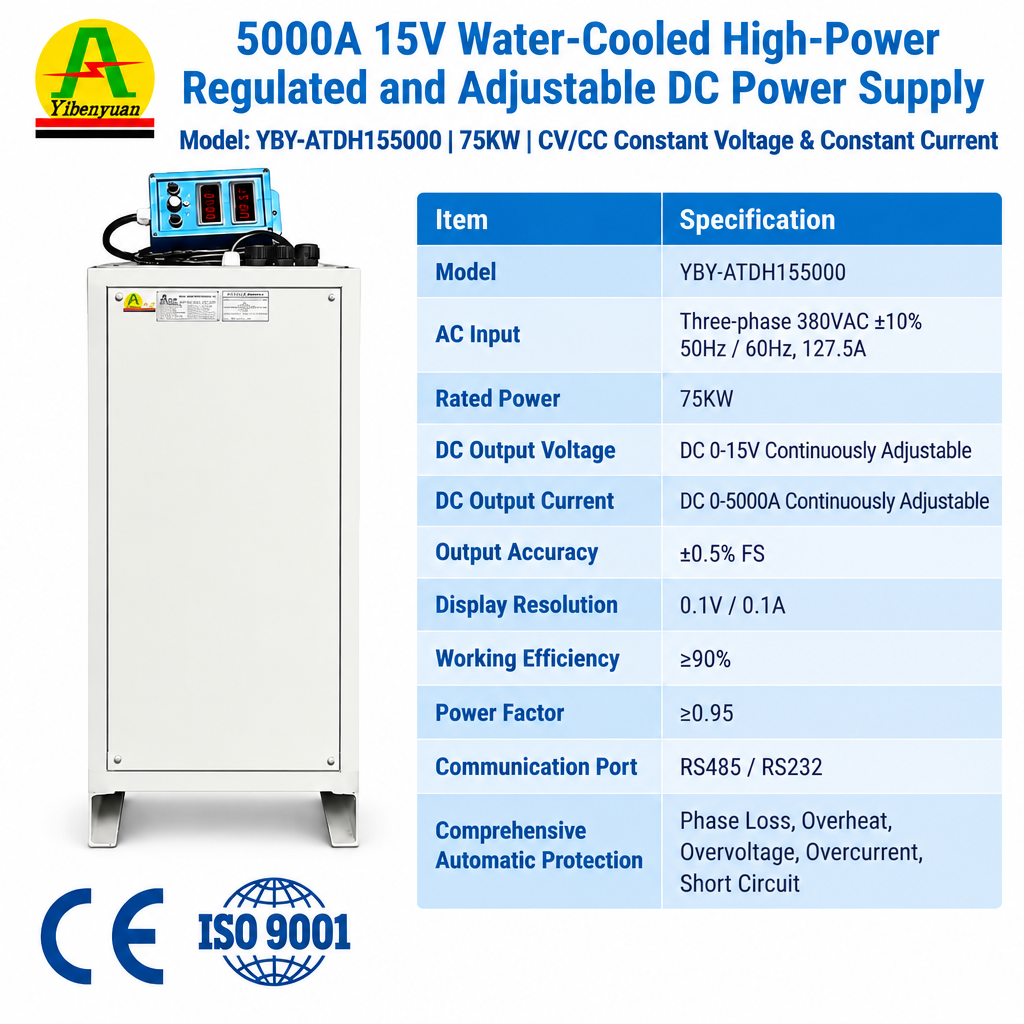
- Output Range0–15V / 0–6000A
- TopologyHigh-Frequency IGBT
- Cooling SystemDeionized/Chilled Water
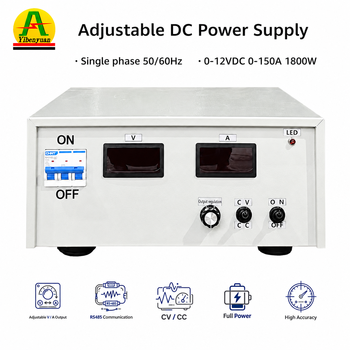
- Regulation ModeCV / CC Auto-Switch
- Ripple Factor≤ 1% RMS Low Noise
- ApplicationPCB, Semiconductor, Precious Metal
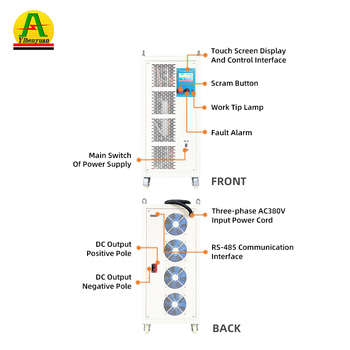
- Nominal Power48 Kilowatt Continuous
- Input Voltage380V/415V/480V 3-Phase
- Remote LinkRS485 Modbus / 0-10V PLC
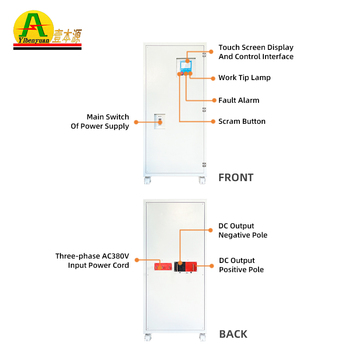
- Busbar LinkSolid Copper Solid-Die
- Corrosion DefenseHermetic Sealed Enclosure
- ProtectionOver-temp, Short, Phase Loss
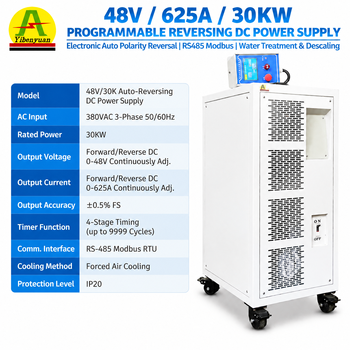
- Cycle Control4-Stage Microsecond Timer
- Target ProcessElectrochemical Descaling
- Control ModesCV Constant Voltage / CC
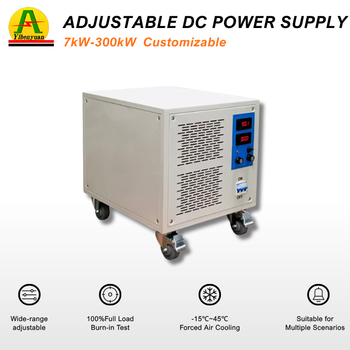
- Voltage Stability≤ 0.1% Line / Load Reg
- Dynamic Response≤ 2ms Step Recovery
- InterfaceCAN, RS232, Analog 0-5V
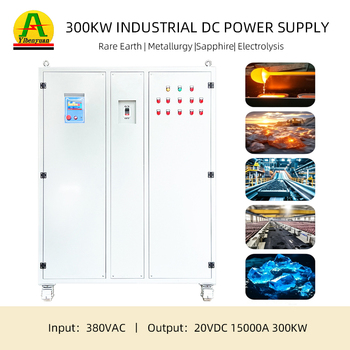
- Current Output0–15,000 Amperes Continuous
- System ConversionUltra-Low Loss IGBT Bridge
- Duty Class100% 24/7 Heavy Chemical Duty
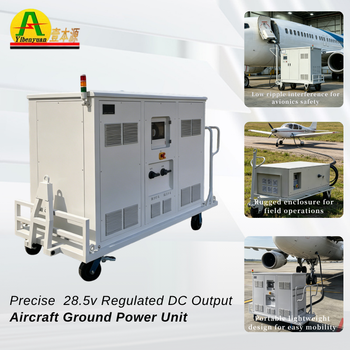
- Voltage Setting28.5V Fixed Low-Ripple
- Peak StartingUp to 2000A Instantaneous
- ChassisRuggedized Field Transport Cart
The Engineering Paradigm Shift in Industrial Constant Voltage Sourcing
Analyzing modern high-frequency SMPS topologies versus legacy thyristor rectifiers in heavy chemical, surface treatment, and precision test environments.
In modern industrial manufacturing—spanning hard chrome electroplating, semiconductor chemical mechanical polishing (CMP), titanium anodizing, water descaling, and new energy vehicle (NEV) motor drivetrain burn-in—the requirement for Constant Voltage (CV) and Constant Current (CC) power supplies has evolved beyond simple step-down transformation. Today's facilities operate within aggressive efficiency parameters, stringent environmental standards, and uncompromising low-ripple thresholds. For overseas procurement directors and system integrators seeking the China Best Constant Voltage Power Supply Supplier, understanding how state-of-the-art power conversion architectures function is essential to avoiding costly premature field failures and thermal losses.
Engineering Axiom: The switch from 50Hz/60Hz thyristor (SCR) architectures to high-frequency IGBT pulse-width-modulated (PWM) inverters running between 20kHz and 50kHz reduces transformer core mass by over 70%, increases electrical conversion efficiency from ≤78% to ≥91%, and limits total harmonic distortion (THD) while achieving sub-1% voltage regulation accuracy across zero-to-full dynamic load steps.
When selecting a constant voltage supply for heavy-load industrial duties, system reliability hinges upon three distinct thermal-electrical domains: semiconductor junction cooling, high-frequency transformer flux saturation immunity, and real-time digital feedback loops. Conventional catalogue supplies fail when operated in corrosive airborne chemical environments or subject to rapid back-EMF spikes from inductive industrial loads. Guangdong Fenvix Technology Co., Ltd. resolves these operational bottlenecks through direct in-house structural engineering, bespoke planar transformers, and encapsulated dual-cooling pathways.
| Evaluation Parameter | Legacy Silicon-Controlled Rectifier (SCR) | Commercial Grade SMPS Supplier | Fenvix Industrial Custom IGBT System |
|---|---|---|---|
| Operating Frequency | 50Hz / 60Hz Line Frequency | 15kHz – 20kHz Variable | 25kHz – 45kHz Resonant Soft-Switching |
| Power Conversion Efficiency | 72% – 80% (Heavy Heat Dissipation) | 84% – 88% | 90% – 93.8% (Measurable Energy Savings) |
| Output Voltage Ripple (RMS) | 5% – 12% without oversized filters | 2% – 3% | ≤ 1% Full Scale (Sub-0.5% Custom Available) |
| Dynamic Load Transient Recovery | Slow: 100ms – 300ms response time | 20ms – 50ms | ≤ 2ms recovery from 10% to 90% step load |
| Cooling Protection Class | Open air convective / noisy fans | Standard internal fan venting | Isolated airflow chamber / Sealed 304 Stainless Water Cooling |
| Corrosion Resistance in Plating Line | Prone to busbar & PCB oxidation | Minimal board-level conformal dip | Triple conformal robotic coating + IP54/IP55 water-cooled cabinet |
Future Sourcing Trends for Constant Voltage Power Infrastructure
Strategic purchasing guidelines for global procurement directors, OEM designers, and chemical line contractors for 2025–2030.
Total Cost of Ownership (TCO) vs Capital Expenditure
Global enterprises are abandoning low-cost initial bids in favor of lifecycle kilowatt-hour evaluations. Operating an 8000A 12V rectifier 24 hours a day at 92% efficiency instead of 80% saves tens of thousands of dollars annually in plant electricity alone, paying off hardware within 14 months.
Hermetic Water-Cooling Domination in Plating
Forced-air fans inevitably draw acid vapors, caustic mists, and conductive metal dust directly across high-voltage IGBT switches. The procurement trend is shifting firmly toward closed-loop liquid chillers with stainless-steel heat exchangers, preventing cross-contamination.
Smart Fieldbus Telemetry & Industry 4.0
Stand-alone analog potentiometers are obsolete in state-of-the-art facilities. Procurement teams specify Modbus-RTU, Profibus, EtherCAT, and analog 0-10V/4-20mA automation links to execute automated microsecond voltage ramps, automatic data logging, and preventive fault diagnostics.
Emerging Power Supply Architecture Roadmap
How Silicon Carbide (SiC), modular N+1 matrix designs, and bidirectional topologies are reshaping industrial power conversion.
Wide-Bandgap SiC MOSFET Integration
The transition from silicon IGBTs to Silicon Carbide (SiC) MOSFETs allows switching frequencies exceeding 100kHz. This yields microscopic ripple profiles essential for deep sub-micron PCB vias, gold electro-deposition, and ultra-compact laboratory rack mounts.
N+1 Hot-Swappable Redundancy Modules
For high-value continuous reel-to-reel plating lines or electrolytic water plants, line shutdowns cost thousands of dollars per minute. Future systems deploy modular power blocks operating in active current sharing. A failing module can be serviced without interrupting the production run.
Bidirectional Regenerative Sourcing
In electric vehicle battery simulation and high-voltage capacitor testing, systems must seamlessly toggle between constant voltage sourcing and regenerative electronic load absorption, feeding brake energy back into the factory grid at 95% recovery efficiency.
End-to-End In-House Manufacturing: From Raw Sheet Metal to Load Test
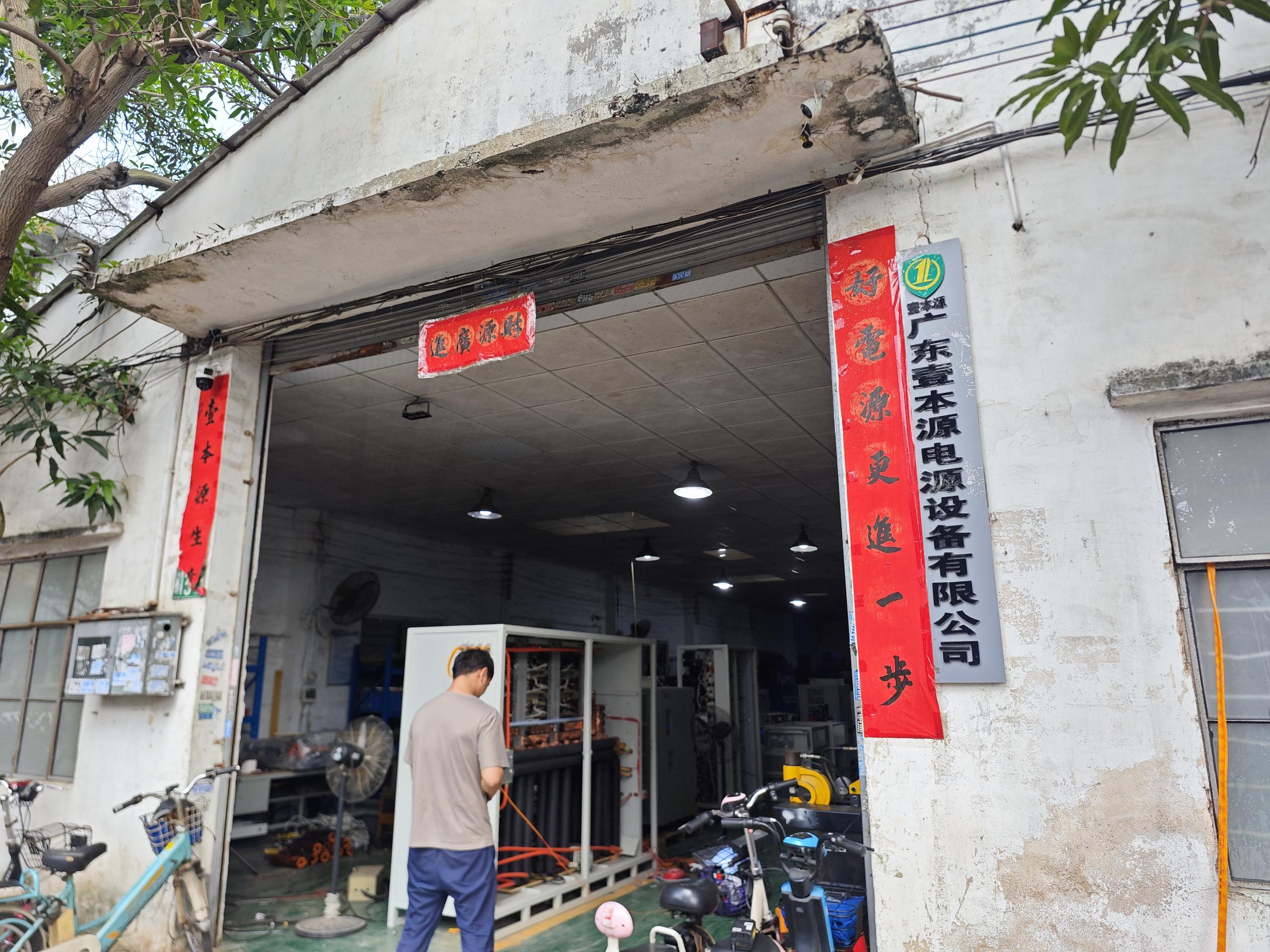
Unlike export traders who outsource assembly to splinter workshops, Guangdong Fenvix Technology Co., Ltd. (founded 2013) maintains full control of design, mechanical sheet metal processing, heavy copper busbar fabrication, surface coating, and high-power burn-in inside our own 3,000m² facility.
- In-House Precision Machinery: Dedicated shearing, CNC punching, milling, drilling, and tapping ensure rock-solid cabinet mechanical shielding and tailored dimensions.
- Engineering-Led Customization: Non-standard grid voltages (208V, 220V, 380V, 415V, 480V 3-phase, 50/60Hz) configured without MOQ penalties. Single prototype builds welcome.
- Verified Quality Management: ISO 9001 certified, selected product CE/RoHS/LVD/EMC compliance, and verified on-site by TÜV Rheinland for total cross-border buyer security.
- Rigorous Oscilloscope Load Testing: Every unit undergoes 100% full-current load bank calibration, dielectric withstand, and thermal scanning prior to export packaging.
Frequently Asked Questions: Sourcing Constant Voltage Power Supplies
Direct technical answers to common engineering, delivery, and configuration inquiries received by our factory team.
What parameters must be provided to engineer a custom constant voltage or constant current power supply? +
Does Fenvix require a Minimum Order Quantity (MOQ) for non-standard voltages? +
When is water cooling technically necessary over forced-air ventilation? +
How does high-frequency switching technology save electricity compared to traditional silicon rectifiers? +
What certifications and verification reports accompany Fenvix power systems? +
What international trade terms and foreign payment currencies are accepted? +
How does your engineering team handle technical support, commissioning, and warranty for international buyers? +
Consult with Guangdong Fenvix Senior Engineers Today
Whether you need a high-frequency water-cooled plating rectifier, an 800V EV component test supply, or an aviation ground power unit, our engineering team will evaluate your electrical parameters and deliver a factory-direct quotation within 24 hours.