[email protected]
ISO 9001 Certified Manufacturer Exporting to 4 Continents
0%

Choosing an Industrial Power Supply is not simply a matter of matching watts on a label. The unit must deliver stable voltage through startup surges, changing loads, and long operating hours. A control cabinet beside a hot production line presents different demands from a clean, temperature-controlled test bench. Small details matter.

Power-electronics professor Robert W. Erickson has shaped widely used engineering education through his work on converter design. A practical paraphrase of that engineering approach is: “Design around the real load, not the catalog headline.” Treat this as a selection principle, not a verbatim quotation. Check output voltage and current, inrush behavior, ripple limits, efficiency, and available protection features. Then review the installation environment, including heat, vibration, dust, and restricted airflow. A supply rated for the expected load may still need derating when cabinet temperatures rise.

This guide explains how to compare specifications, choose suitable mounting and cooling, and assess reliability and maintenance needs. It also highlights common trade-offs between compact size, efficiency, redundancy, and cost. Keep the application in view. A tidy datasheet cannot capture every startup cycle or future load change, and that uncertainty deserves honest review. Verify critical requirements against the manufacturer’s documentation and, where needed, test the supply under representative operating conditions. The right choice is the one that performs reliably in the actual system—not merely the one with the most impressive headline rating.
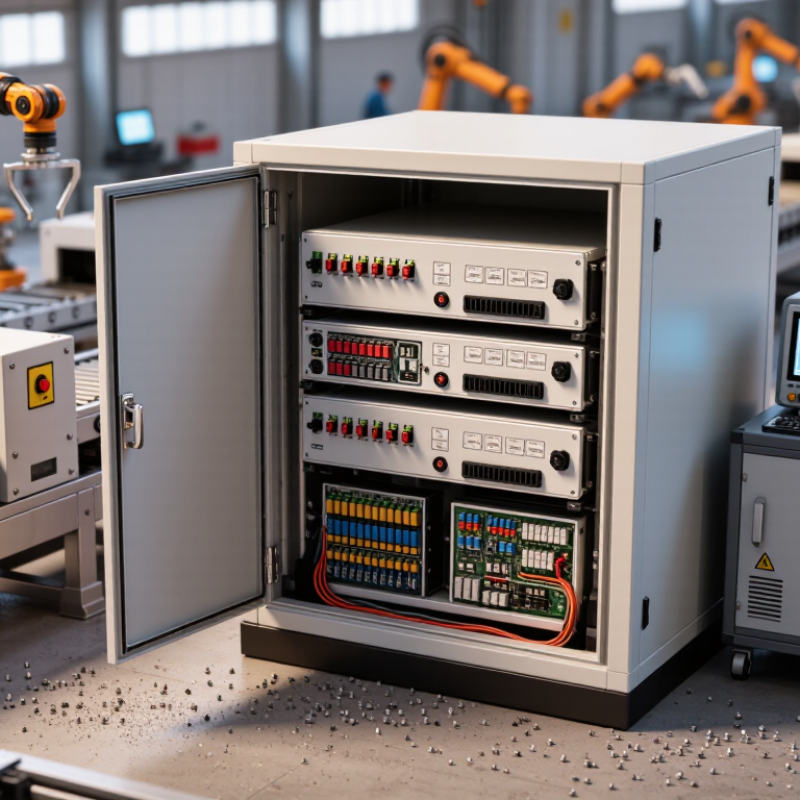
2026 How to Choose an Industrial Power Supply?

Calculate Load Demand and Allow 20–30% Capacity Headroom

2026 How to Choose an Industrial Power Supply?
Calculate Load Demand and Allow 20–30% Capacity Headroom

Begin with the actual load, not a guess based on equipment size. Add the rated input current of every device that may run at the same time. For a 24 V system drawing 8 A continuously, the load is 192 W. Adding 25% headroom gives a target of about 240 W. A useful starting point, not a guarantee. Check startup surges from motors, solenoids, and capacitive loads; their brief peaks can exceed steady-state demand. The U.S. Department of Energy’s 2014 Industrial and Commercial Motor System Market Assessment Report estimates that motor systems account for 68% of industrial electricity use. That makes motor loads especially important to measure, not simply assume.

Allow 20–30% spare capacity for load changes and future additions, then check the supply’s derating curves. High cabinet temperatures, restricted airflow, and low input voltage can reduce available output. IEC 60204-1 also emphasizes matching electrical equipment to its supply conditions. Read the equipment nameplates, then verify the calculation with a clamp meter during normal operation and startup. Measurements are better than estimates, but one reading can still miss a rare peak. Recheck after installation, especially if several machines start together. A small margin may be enough for steady loads; intermittent peaks may call for more.

Match AC Input, DC Output, and Transient-Load Requirements

2026 How to Choose an Industrial Power Supply?

Match the AC input to the real site conditions, not just the label voltage. Check the acceptable voltage and frequency range, including dips, startup behavior, and single- or three-phase wiring. Then confirm the DC output voltage and continuous current at the actual enclosure temperature. A supply rated for 10 A may deliver less when mounted in a hot, sealed cabinet. Small mismatch.

Transient loads need their own check. A relay coil, valve, or motor drive can briefly draw far more current than its steady-state rating suggests. Record peak current, pulse duration, and repetition rate, then compare them with the supply’s overload curve and recovery behavior. The U.S. Department of Energy’s 2023 U.S. Industrial Motor Systems Market Assessment reports that motor-driven systems use about 54% of U.S. manufacturing electricity. That scale makes startup and switching events worth measuring, not guessing. I would still verify the load waveform on the machine; a datasheet alone can miss the sharpest pulse.

Tips: Test at the lowest expected AC input and highest cabinet temperature. Check the waveform. Allow margin for future loads, but avoid oversizing without reason: it can add cost and leave light-load efficiency unexamined. Keep a note of the test setup and measured peak current for later maintenance.

Compare 80 PLUS Efficiency at 20%, 50%, and 100% Load

2026 How to Choose an Industrial Power Supply?

When comparing 80 PLUS efficiency, check performance at 20%, 50%, and 100% load—not just the certificate level. CLEAResult’s 80 PLUS criteria show that, at 115 volts, Gold-rated supplies must reach 87%, 90%, and 87% at those points. The figures describe AC-to-DC conversion efficiency under defined test conditions. They do not guarantee identical performance in a hot cabinet or with a different input voltage. Check the exact test listing.

Small differences add up. At 50% load, a 500-watt supply delivers 250 watts; at 90% efficiency, it draws about 278 watts from the wall. Roughly 28 watts becomes heat. At 20% load, the same supply delivers 100 watts; 87% efficiency means about 115 watts drawn. That gap matters. The U.S. Department of Energy’s 2024 data-center report estimates U.S. data centers used 176 terawatt-hours in 2023, a reminder that conversion losses matter at scale. For industrial equipment, measure the real load across idle, typical, and peak operation. I would not choose from one test point alone; actual duty cycles can be messier than a neat table. Also confirm that the certification applies to the supply type you are evaluating.

2026 How to Choose an Industrial Power Supply? — Compare 80 PLUS Efficiency at 20%, 50%, and 100% Load
80 PLUS Certification Level Minimum Efficiency at 20% Load Minimum Efficiency at 50% Load Minimum Efficiency at 100% Load Illustrative AC Input at 500 W DC Output* Practical Selection Consideration
Standard 80% 80% 80% 625 W Consider for cost-sensitive applications where power conversion losses are less critical.
Bronze 82% 85% 82% 588 W A basic efficiency option; check the expected operating load and enclosure temperature.
Silver 85% 88% 85% 568 W Offers higher certified efficiency than Bronze across the listed load points.
Gold 87% 90% 87% 556 W A common efficiency target for systems that operate for long periods or at substantial load.
Platinum 90% 92% 89% 543 W Higher efficiency can reduce conversion losses; confirm that the extra cost suits the duty cycle.
Titanium 92% 94% 90% 532 W Provides the highest efficiency thresholds in this comparison, including strong performance at 20% load.

Efficiency thresholds shown are the 115 V AC internal, non-redundant 80 PLUS criteria at the specified load points. Certification thresholds depend on the test category and input voltage. *The illustrative input figures are calculated as 500 W divided by the 50% load efficiency; they are not measurements of a specific power supply. For industrial use, also verify the manufacturer’s datasheet for input-voltage range, output ratings, operating temperature, derating, protection features, and the required safety approvals. 80 PLUS efficiency certification alone does not establish industrial suitability.

Check IEC 61000-3-2 Harmonic Limits for Inputs ≤16 A per Phase

2026 How to Choose an Industrial Power Supply?

Check IEC 61000-3-2 Harmonic Limits for Inputs ≤16 A per Phase

For an industrial power supply drawing no more than 16 A per phase, check its harmonic emissions against IEC 61000-3-2. The threshold applies per phase, not to the supply’s total current across all phases. The standard sets limits for harmonic currents that equipment sends back into public low-voltage systems. It is not an immunity test.

Confirm how the power supply is classified under the applicable edition. IEC 61000-3-2 uses equipment classes, and the correct class depends on the product’s characteristics and intended use. A label saying “PFC included” is not enough. Ask for a test report covering the exact model, input voltage, frequency, and operating conditions. Check the edition adopted in your target market, too.

Look closely at the test setup. A supply may behave differently at light load than near full load, especially when paired with control electronics or multiple units. That detail is easy to miss. Compare the report’s load conditions with your cabinet’s real operating range, and confirm whether the tested configuration matches your installation. If the documentation is unclear, ask the manufacturer for the relevant harmonic-current data before selection.

Verify IEC 62368-1 Safety and Operating-Temperature Ratings

When comparing industrial power supplies, verify the exact safety standard and certificate for the specific model. IEC 62368-1 uses a hazard-based approach to reduce risks from electrical energy, heat, and fire. Check the supplier’s declaration, certificate scope, and revision; a logo on a listing is not enough. Confirm that the evaluated model matches its output, enclosure, and intended installation. Small suffixes matter.

Then read operating-temperature ratings closely. A range such as –20°C to +70°C may describe ambient temperature, but full output may not be available across that range. Look for derating curves, which show how allowable load changes as temperature rises. In a sealed cabinet beside a motor drive, intake air can be much hotter than the room. Leave margin. Also check airflow direction, mounting orientation, and any altitude limits.

Estimate cabinet temperature at the power supply’s air intake, not at the building thermostat. Compare that value with the derating curve and the load’s peak demand. Ask for test conditions when the data sheet is vague. A rating without its conditions is incomplete. IEC 62368-1 may be relevant, but the equipment’s intended use and applicable product requirements still need review. Do not treat compliance as proof of suitability. Keeping a record of the chosen model, certificate, ambient estimate, and derated output feels tedious, but it makes later changes easier to assess.

FAQS

How do I estimate the power supply capacity I need?

Add the input current of devices that may run together, then multiply by system voltage. A 24 V system drawing 8 A needs 192 W. Add 20–30% headroom, giving roughly 230–250 W. Treat this as a starting point.

Why should I check startup current?

Motors, solenoids, and capacitive loads can briefly draw more current than they use during normal operation. A clamp meter can help capture these peaks during startup. One reading may miss an unusual event. Recheck when several machines start together.

How can I account for cabinet conditions?

High temperatures, poor airflow, and low input voltage can reduce a supply’s available output. Check its derating curves against the cabinet’s actual conditions. A calculation alone may not be enough.

Which efficiency figures should I compare?

Compare efficiency at 20%, 50%, and 100% load, rather than relying on one figure. A 500 W supply delivering 250 W at 90% efficiency draws about 278 W. Roughly 28 W becomes heat. Real duty cycles can be messy.

Does an efficiency rating guarantee performance in my installation?

No. Test figures use defined conditions, which may differ from a hot cabinet or your input voltage. Check the exact test listing and measure consumption during idle, typical, and peak operation. I would double-check this.

When should I check harmonic emissions?

Check the applicable harmonic-emission limits when input current is no more than 16 A per phase. The threshold applies to each phase, not the combined current across phases. This is not an immunity test.

What should a harmonic test report include?

Confirm the equipment classification and applicable standard edition. Ask for results covering the exact model, input voltage, frequency, and operating conditions. Compare the tested load with your installation. A label alone is not enough.

Conclusion

Choosing an Industrial Power Supply begins with calculating the equipment’s expected load and adding 20–30% capacity headroom to accommodate growth and short-term demand. Confirm that the unit’s AC input range and DC output match the system, and check that it can handle transient loads such as startup surges without voltage instability. These steps help ensure reliable operation under both normal and demanding conditions.

Next, compare efficiency across 20%, 50%, and 100% load rather than relying on a single rating. For AC inputs of 16 A per phase or less, verify that harmonic performance meets the applicable IEC 61000-3-2 limits. Also review IEC 62368-1 safety compliance and the specified operating-temperature range, making sure they suit the installation environment. A careful comparison of capacity, electrical compatibility, efficiency, harmonics, safety, and temperature ratings can help identify a supply that fits the application and supports dependable long-term performance.

Ethan

Ethan

Ethan is a professional marketing specialist with a deep understanding of the company’s products, customers, and the needs those products are designed to address. He regularly contributes expert articles to the company website, sharing clear, practical information that helps readers understand......